
TL;DR
- Darrell Fear helped build the Lloyds Banking Group AI Academy, which has helped 67,000 colleagues use AI with confidence. His biggest lesson is that the academy is only one part of an adoption system.
- Logins and completions show who took part. Only evidence from inside the workflow shows whether the work has changed.
- Assess before you train, group people by the work they do, and fix the conditions around them: access, time, guardrails and manager backing.
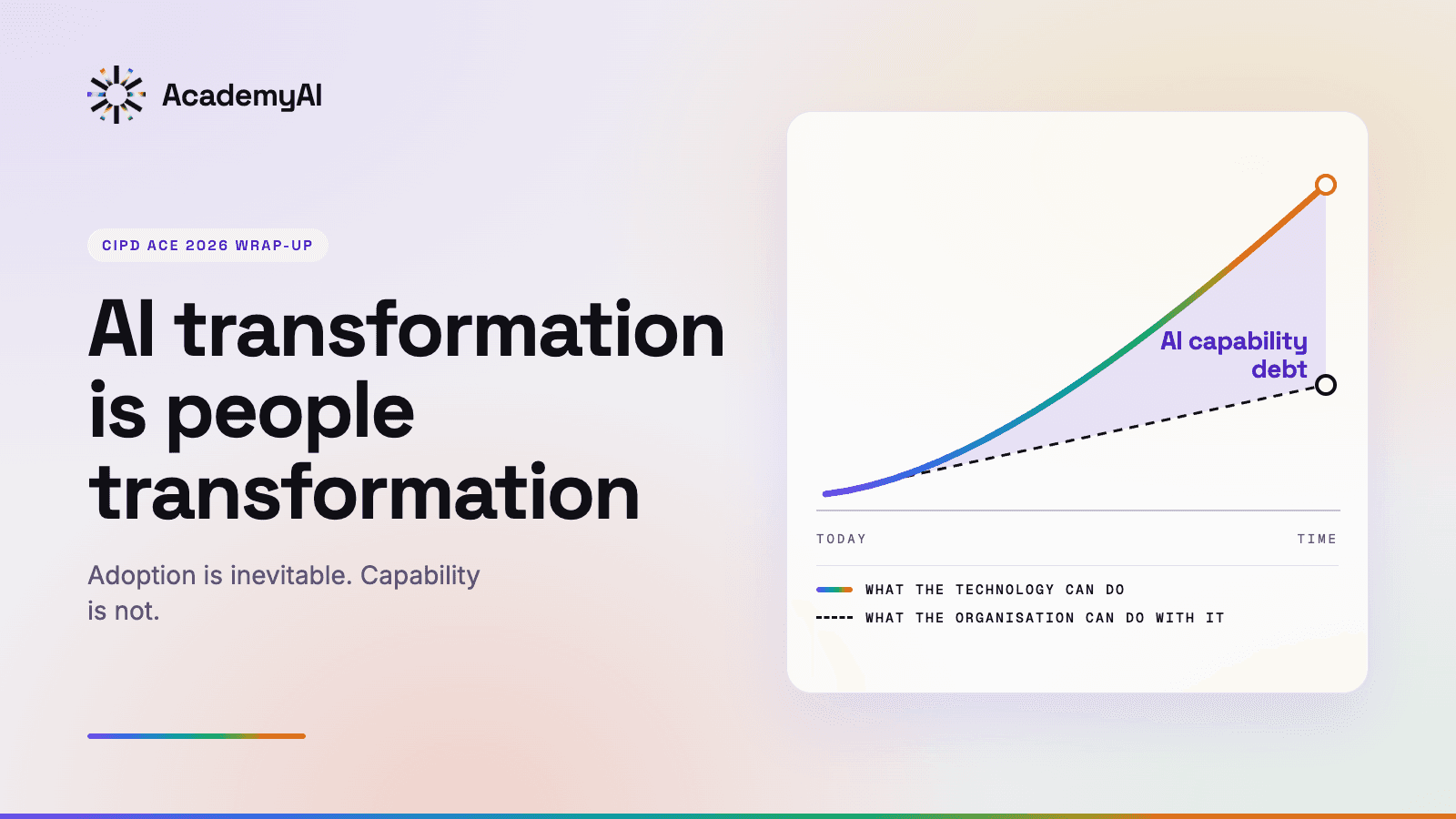
- Capability debt is the growing gap between what your strategy needs from people and what they can actually do. AI speeds it up.
- Before you fund any training, answer five questions about the outcome, the roles, the standard, the conditions and the evidence. Then give ownership to the business.
In the latest episode of our Capability Loop Podcast, we spoke to Darrell Fear, who spent 24 years at Lloyds Banking Group and helped build the AI Academy behind one of the UK's most ambitious workforce programmes. His work has helped 67,000 colleagues use AI with confidence, skill and good judgement. He now runs Adoptive Learning Consultancy.
Few organisations are working at that scale. But what Darrell learned applies to almost any team trying to turn AI investment into real change at work.
Watch the full conversation, listen to the episode, or read the summary below.
Seven takeaways for building AI capability at any scale
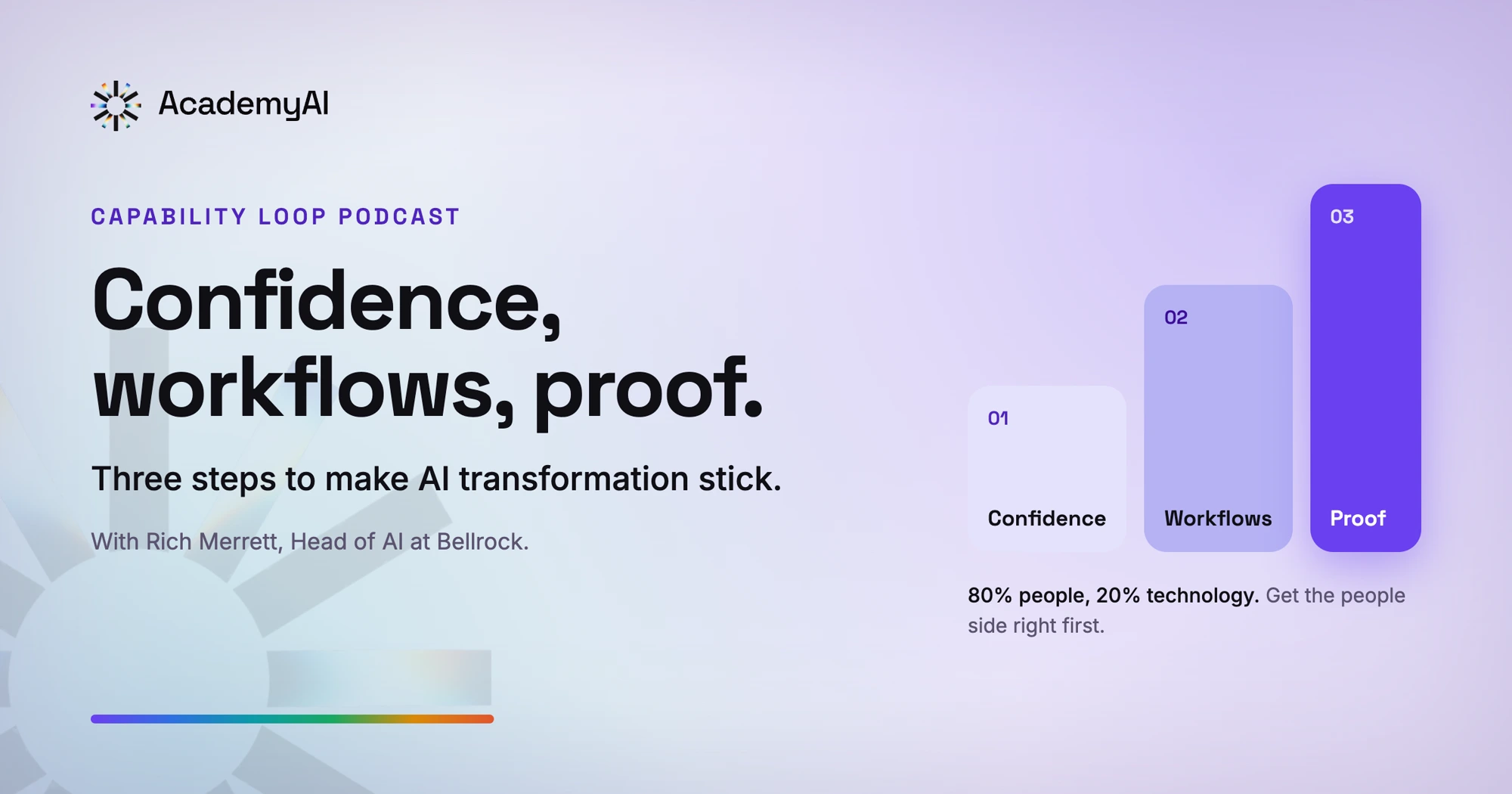
- Giving people a tool doesn't mean they've adopted it, and finishing a course doesn't make them capable. Logins and completions show who took part, but they don't show whether anyone's work has actually changed.
- Assess before you train. Asking people how confident they feel tells you little. A realistic scenario shows what they would actually do.
- Group people by the work they do, not by the tool they use. A few clear starting points work better than a long menu.
- Fix the conditions around people. Access, time, permission, guardrails, manager backing and relevant examples all matter. Better content can't make up for any of them being missing.
- Give managers a job in adoption, not just messages to pass on.
- Measure how workflows change, not how many courses get finished. Decide how you'll measure it before you launch.
- Start from the business problem. Watch for capability debt: the growing gap between what your strategy needs people to do and what they can actually do.
Logins are not the finish line
In its first three months, the Lloyds academy logged more than 300,000 learning completions, and active AI use climbed to 41% from a low base. But those numbers don't show the whole picture.
Completions show that people showed up, and usage shows that they experimented. Only evidence from inside the workflow shows whether the work has actually changed.
Darrell points to a field study of just over 7,000 workers across 65 firms. People using generative AI spent less time on email, but the overall amount and mix of their work stayed much the same. Individual time savings don't automatically become organisational gains. That's why he treats workforce capability as infrastructure for creating value and managing risk, not as the soft side of a tech rollout.
Our view: if your board report still opens with login numbers, it's measuring the wrong thing.
Building for thousands of different roles
Four decisions shaped the Lloyds approach.
Assessment came before training. Self-reported confidence measures how people feel, not what they can do. So the team built scenario-based diagnostics that put people in realistic situations. Should this data go into the tool? At what point does a person need to take the decision instead?
Learning was organised around the work. A branch colleague in Cardiff, a relationship manager with a large commercial portfolio and an engineer working in GitHub Copilot all day need very different support. Instead of 30 or 40 confusing entry points, Lloyds settled on four broad groups: everyday users, builders, leaders and the people who make the work possible.
Content became habits. Learning was turned into simple principles people could share and practise in their day-to-day work, whether hourly, weekly or monthly.
The environment mattered most. This is the point Darrell feels most strongly about. People can only use what they've learned if the conditions around them allow it. In his words, build capability around the decisions and workflows people carry out, not around the tool.
Looking back: the academy is one part of a bigger system
Darrell would build the academy again. But he'd be clearer from the start that it was one part of an adoption system, not the centre of it.
Three things would change. First, he'd measure a few priority workflows before launch, so people could see what was in it for them. Second, he'd give managers a defined role in reinforcing new habits, because middle managers decide whether their teams get the time and safety to practise. Third, he'd plan how learning would be sustained before day one. The practical "try this today" material came later than he wanted.
The research backs him up. One meta-analysis on learning transfer found that support from peers, supervisors and the organisation together explained around 32% of the difference in whether training was applied at work.
When capability depends on a campaign, only the enthusiasts keep it going. For it to last, it has to be built into roles, onboarding, workflow standards and clear ownership.
When the gap between strategy and skill keeps growing
Since leaving Lloyds, Darrell has been developing the idea of capability debt: the gap that builds up between what an organisation's strategy needs from people and what they can actually do.
Some gap is normal during any transformation. It becomes debt when a tool goes live without a shared view of what good use looks like. Guardrails differ from team to team, managers aren't prepared and nobody measures a starting point. Adoption stays patchy, and the usual answer is another course, another campaign or another tool.
Darrell sees six warning signs:
- Unowned: nobody is responsible for the outcome
- Underdefined: the ambition was never turned into something you can observe
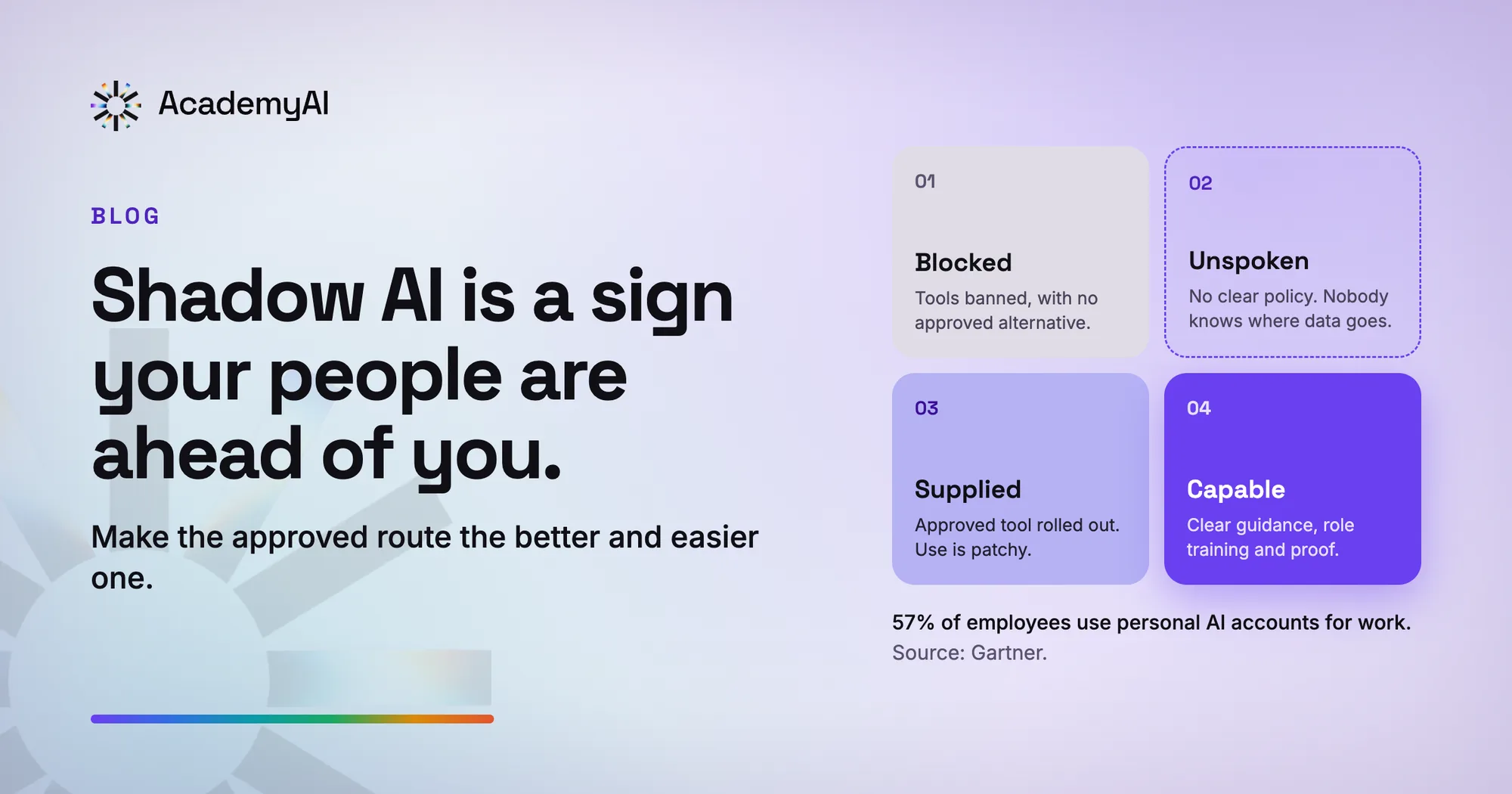
- Unsupported: people don't have the time, access or guardrails they need
- Unreinforced: managers and systems don't keep new behaviours going
- Unevidenced: activity is visible, impact isn't
- Unanchored: capability never becomes part of roles, onboarding or performance
When he asked one chief people officer who actually owned the outcome of their AI work, they admitted they didn't know. It's something we see a lot in our conversations with businesses rolling out AI.
Capability debt doesn't appear as a line on the P&L. It shows up as slower adoption, rework, inconsistent practice and ROI you can't see. As Darrell puts it, AI doesn't create capability debt. It speeds it up.
Five questions to answer before you fund any training
If a CEO were starting from scratch, Darrell wouldn't tell them to build an academy first. You can keep doing the wrong thing more efficiently, or start doing the right thing properly. Doing the right thing starts with five questions for the leadership team:
- What business outcome or risk makes this urgent now?
- Which roles and workflows need to change?
- What do people need to do differently, and to what standard?
- What conditions need to be in place around them?
- What evidence will show it has worked?
If any of the answers are unclear, you're not ready to start.
These questions also settle who owns the work. Technology can't own behaviour. Learning can't own governance or workflow design. The outcome has to sit with the business. So rather than asking your CEO to pay for training, ask them to sponsor measurable capability in the workflows that matter most.
Where AcademyAI fits
You can do all of this yourself, or you can do it with AcademyAI. Before any training starts, we assess each person's AI capability against their role. We then build that capability through role-specific learning delivered in the flow of work, and show the change in the work itself. academyai.co
You can launch a programme in a day. Capability only grows when the system around your people changes too.
Darrell shares more of his research on capability debt on LinkedIn. He's well worth following.