TL;DR: At CIPD ACE, our chair, Rob Barnett, gave a presentation that argued buying AI tools is the easy part - the real challenge is closing the growing gap between the technology organisations have and their people's ability to use it well. The transformation we need requires redesigning work and not just speeding up tasks, equipping managers differently, measuring actual capability rather than training completion, and putting the people profession at the centre of the change. AI adoption is inevitable; AI capability is not and the organisations that can close that gap fastest will win.
Last week at CIPD ACE in Manchester, the conversations kept coming back to the same issue: organisations have bought the tools, the licences are live and Boards are talking about AI in the annual report. Yet when you ask the questions about how work is actually changing, which skills matter the most and how you know your people can use the technology well, the answers are harder to find.
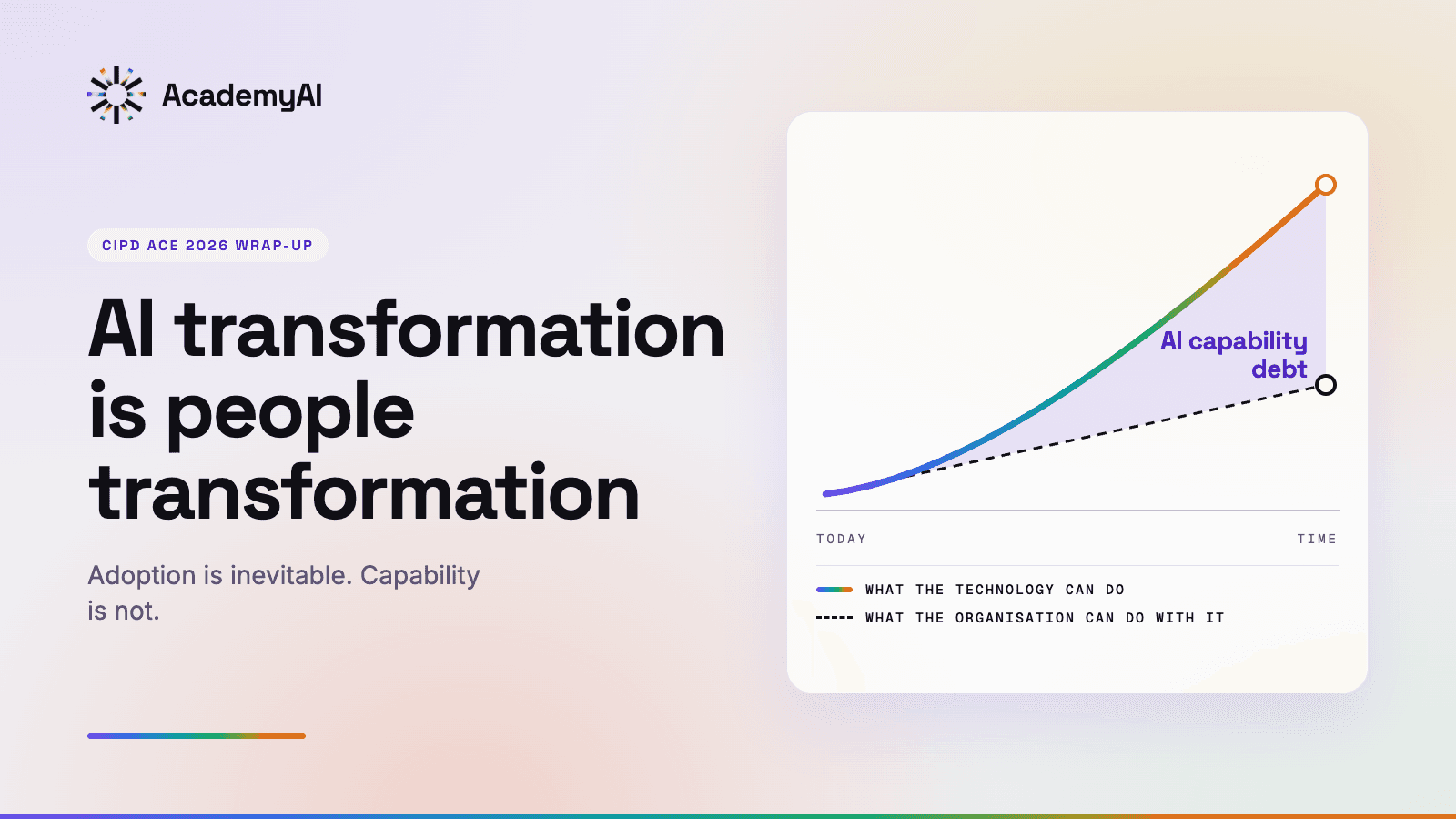
That gap is what we call AI capability debt. And it was the focus of our chair, Rob Barnett's, talk on the Future of Work stage on the event floor.
Productivity at a task level isn't transformation
Most organisations are still chasing AI productivity at the level of the individual task - write this faster, summarise the meeting, analyse the data quicker. Useful, yes, but purely at a personal productivity level. According to BearingPoint research, 73% of the FTSE 250 are essentially looking to make current tasks more efficient and that's not transformation.
True transformation starts when someone asks what happens to the role when 20-30% of its activity changes. What fills the time that is freed up? Do we redesign the work, change spans of control, reinvest the capacity, or simply let everyone become 30% busier until the gain disappears?
Doing the same work faster delivers short-term benefits but real change begins and real results are seen when AI alters the shape of the work itself.
Adoption is inevitable. Capability is not.
AI has reached the boardroom, it has reached investors and the technology estate, but it has not yet reached the systems and practices that the people profession shapes: job architecture, workforce planning, skills frameworks, performance management, career pathways, leadership expectations and reward.
Most of those systems were designed for a world in which humans did virtually all of the work - AI changes that assumption. When the technology moves faster than the organisation's ability to adapt, capability debt accumulates, and so does the growing gap between what the tools could deliver and what the organisation is actually capable of doing with them.
Technology improves almost weekly. Organisational capability, management practices, job design and culture do not. The organisations that close the gap fastest will be the ones that win.
Managers are the transmission mechanism
Strategy and policy do not redesign work. Managers do. They decide whether the team keeps working exactly as before with some new software, or whether how the work gets done actually changes. They are the ones who will redeploy capacity, judge when AI output is good enough, manage anxiety, and translate corporate ambition into what happens at 10 o'clock on a Tuesday morning.
Yet in many organisations, the mistake is that managers receive the same generic AI training as everyone else. They need a different capability set: work redesign, capacity, quality, judgement, performance and leading people through uncertainty. Managers may be among the most important - and least prepared - people in any AI strategy.
How do you assess who is actually capable?
Today most organisations know who attended the training and who uses the tools but usage and course completion are not the same as capability.
At AcademyAI we measure capability across six dimensions:
- Literacy - understanding what AI can and cannot do
- Responsible use - data, privacy, security, governance and boundaries
- Framing - identifying the real problem to solve
- Specification - clearly defining context, constraints, desired output and standard
- Application - using AI inside real work, not just in a training exercise
- Evaluation and reflection - judging whether the output is actually any good
This last point matters enormously. Obviously bad AI is easy to manage but very good AI that is occasionally wrong is far more dangerous.
Once you have that profile across a function, a business unit or the whole organisation, and can see how it changes over time, capability actually becomes workforce data. That is when the people profession can make better decisions about where the gaps are, where investment is needed, and whether capability is actually improving.
From activity metrics to "so what?"
Learning ROI is about to become harder to defend if we simply keep measuring attendance, completion and satisfaction scores. The questions that will increasingly be asked are: Are they using it? Did productivity improve? Did we remove work? Did we create capacity? What was the return?
AI gives the people profession an opportunity to move from measuring learning activity to measuring workforce capability and business impact. Completion is not the outcome. Capability and impact are.
The choice for the people profession
HR can become the function that deals with the consequences of AI, or it can help shape the AI-enabled organisation before those consequences arrive. That means moving higher up the value chain - asking where AI will change the economics of work, where we should automate, augment or protect human judgement, what capability we need, and what workforce we therefore require.
Almost every serious consequence of AI eventually becomes a people question. The technology will keep getting better - that is guaranteed. The question is whether the organisation will get better with it. And that depends on your people, not on the tools they use.
AI transformation is people transformation. And that puts the people profession right at the centre of it.
If you were at CIPD ACE and want to continue the conversation, or if you're wrestling with the same questions in your organisation, we'd love to hear from you.