Start here
1. Literacy
Aby AcademyAI
5 lessonsNot startedComplete
HR is being asked to lead AI capability across the organisation, and to use these tools well in its own work. AcademyAI helps you do both, with evidence at every step.
One loop for building AI capability across the workforce, run by HR.
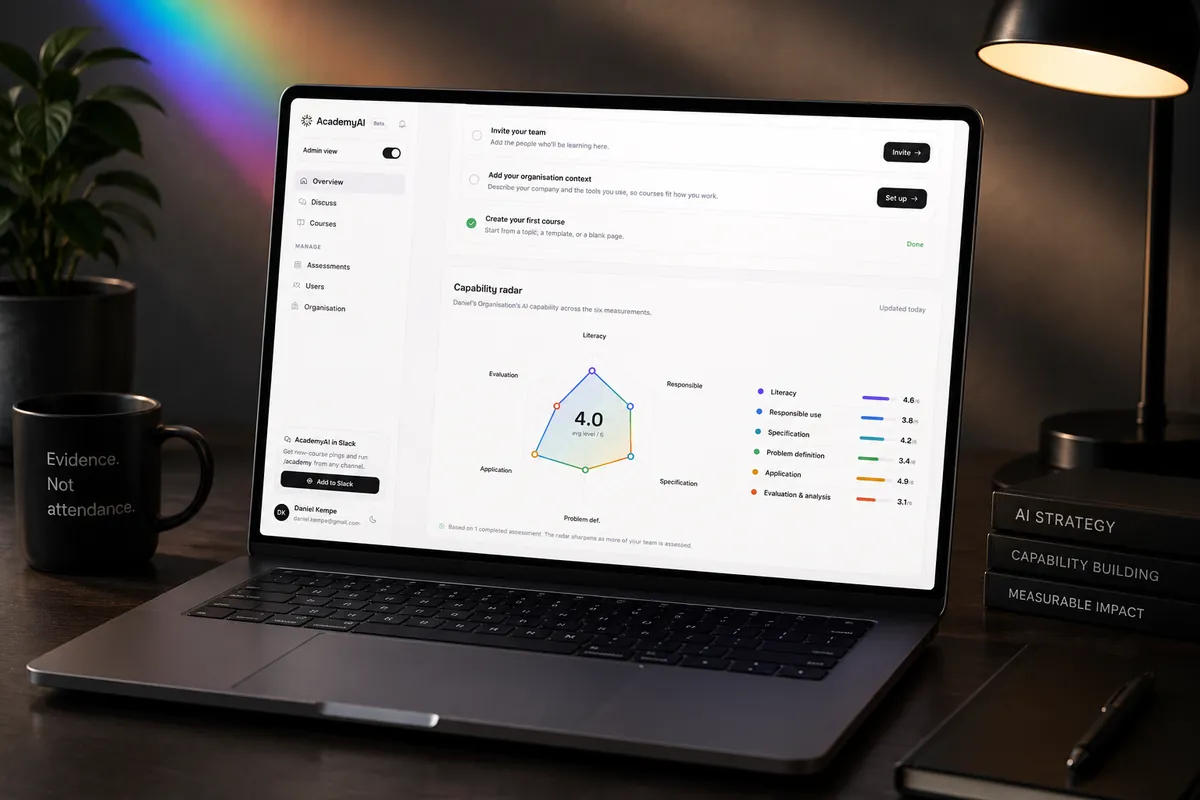
Baseline every team on judgement, output quality and safe use, scored across six measurements.
Role-based courses for each function, so recruiters, managers and finance each learn what their work needs.
Approved workflows for people processes, with the guardrails HR sets built in.
Capability by team, role and site. Re-assess and report the change.
Every employee is mapped on the same six measurements, so you can plan learning, spot risk and compare teams fairly.
Courses close the gaps the assessment finds, written for the work each function does. Your policies and approved tools sit inside the lessons.
See the capability modelTurn the best way to write a job ad, prepare a review or answer a policy question into a shared workflow. HR approves it once and everyone uses the same version.
See AI capability by team, role and location. Track the change after each programme and take real evidence to the board.
Sign up for free DashboardAcademyAI turns your AI investment into outcomes, not another generic L&D catalogue. Four things set it apart.
Completion rates tell L&D who attended. AcademyAI measures capability, graded against rubrics and visible to managers, so HR reports evidence, not a participation log.
A recruiter, an HR business partner and a reward lead use AI differently. Modules and assessments match the work each role does and is accountable for.
Structured tasks rooted in your own handbook, policies and HR systems, so practice turns into how the people team works.
Your AI tools will change more than once in the next three years. We train judgement, application and ethics, so your L&D investment stays useful.
Procurement signed the licences. IT rolled out the seats. Now HR is asked to make it stick, and the gap shows up as shadow usage, uneven output and people risk nobody has measured.
For HR, the number that matters most is the first one: people stay where their skills grow.
Most AI training for HR teaches the HR team a few prompts. That is half the job. The other half is leading capability for everyone else.
Procurement bought the licences. IT rolled out the seats. Now the board wants to know whether people can actually use them.
HR handles some of the most sensitive data in the organisation. Your team needs to know what to hand to a tool, and what never to.
Every role is scored on the same six capabilities. Here is how each one shows up in HR work.
Knows a tool can summarise a grievance file, and that it can also miss what matters.
Strips names and health details before drafting, and checks job adverts for exclusionary language.
Uses help for first drafts of policy FAQs. Keeps disciplinary decisions with people.
Builds one shared prompt that answers policy questions from your own handbook.
Onboarding plans, interview question sets, engagement survey themes.
Checks every draft before it reaches an employee, a candidate or a tribunal bundle.
When one adviser finds a workflow that works, it becomes the team standard, with governance. A few to start with:
Finding the clause and drafting a reply an employee can follow.
That the answer matches the current policy and the person's contract.
First draft of the advert, plus a check for biased or exclusionary wording.
Pay, requirements and tone before it goes out.
Structured questions and scoring guides for each competency.
Fairness and consistency across every candidate.
Grouping hundreds of free-text comments into themes with examples.
That themes reflect what people said, and that nobody can be identified.
A first plan built from the role, team and your onboarding checklist.
Fit with the manager's real priorities.
A dated timeline of events from investigation notes.
Accuracy, neutrality and anything the notes left out.
Every organisation sits somewhere between unmanaged AI adoption and a self-sustaining, AI-native operation. Most are at the very first stage. Few realise it.
AI is everywhere and nowhere. HR cannot see who uses what, or how well.
HR can see capability across the workforce: strengths, gaps, who is ready and who needs support.
People apply AI confidently and consistently to the real work of their roles.
AI capability is part of how work gets done, from onboarding to performance reviews.
The organisation renews its own AI capability as fast as the technology changes.
Completion rates tell you who clicked. AcademyAI tells you who can do the work.
No. AcademyAI is not an HR system. It is an AI capability platform: it assesses how well people use AI tools, trains the gaps by role, and shows what changed. HR teams use it to lead AI capability across the organisation and to build their own.
Short, role-based courses built around real HR tasks: policy queries, job adverts, interview packs, onboarding plans, survey themes and case chronologies. Every course maps to the six capabilities, with safe use of personal data and fairness checks built in.
The training teaches people what they can hand to a tool and what they never should, including personal and special category data. Our security page sets out how AcademyAI stores and protects your own data.
Article 4 asks organisations that use AI systems to take measures to ensure their staff have a sufficient level of AI literacy. AcademyAI scores literacy and safe use by role, so you have a record of where staff stand and what has been done to build it. It supports your approach but is not legal advice.
ChatGPT, Microsoft Copilot, Claude and Gemini, plus the other tools your teams already use. We train the underlying capability, so it stays useful when the tools change.
An LMS or catalogue delivers content and tracks completion. AcademyAI assesses real capability, trains the gaps by role and re-assesses, so you can report what people can do, not who attended. It can sit alongside the learning platform you already use.
No. AcademyAI is a direct subscription, not a levy-funded apprenticeship. That means no fixed programme length, and you can see progress from the first re-assessment.
Take the free capability diagnostic to see where your organisation stands, or book a 30 minute demo and we'll walk you through a rollout that starts with the HR team.
Get a capability radar for your organisation and a plan to close the gaps, starting with HR.