
Practitioner story · Lloyds Banking Group

Building AI skills for 67,000 people: what Lloyds learned.

The academy behind one of the UK's most ambitious workforce programmes worked. The bigger lesson is that an academy only works as one part of a wider adoption system.

From the Capability Loop podcast, with Darrell Fear. Lessons any leadership team can apply, whatever AI tools you use.

Read the 6 lessons
At a glance
colleagues helped to use AI with confidence
67,000
learning completions in the first three months
300,000+
active AI use after three months, from a low base
41%
learner groups, instead of 30 or 40 entry points
4
The starting point

Logins are not the finish line.

Darrell Fear spent 24 years at Lloyds Banking Group, where he helped build the AI Academy. By most measures it was a success from day one. Completions climbed fast and active AI use rose sharply from a low base.

Darrell is clear about what those numbers do and do not show. Completions show who turned up. Usage shows who is experimenting. Only evidence from inside the workflow shows whether the work itself has changed.

He points to a field study of people using generative AI. They spent less time on email, but the overall amount and mix of their work stayed much the same. Time saved by an individual does not automatically become a gain for the organisation.

That is why he treats workforce capability as infrastructure for value and for managing risk, not as the soft side of a technology rollout. If a board report still opens with login numbers, it is measuring the wrong thing.

300,000+learning completions in the academy's first three months: proof of reach, not of changed work.Darrell Fear · Lloyds Banking Group
41%active AI use after three months, from a low base. A strong start, and still only the first receipt.Darrell Fear · Lloyds Banking Group
The lessons

Six lessons in building AI capability at scale.

Practical moves any leadership team can apply, whatever AI tools you use.

Assess before you train

Self-reported confidence measures how people feel about AI, not what they can do with it. So the Lloyds team built scenario-based diagnostics before designing any training.

Confidence survey
Tells you how people feel. Useful for mood, misleading as a baseline.
Scenario-based diagnostic
Shows what someone would actually do, which tells you where to start and who needs what.
Organise learning around the work, not the tool

A branch colleague in Cardiff, a relationship manager with a large commercial portfolio and an engineer using a coding assistant all day do not need the same course. Rather than offer 30 or 40 entry points, Lloyds settled on four groups.

Everyday users
Applying AI to their own day to day tasks.
Builders
Creating solutions others will rely on.
Leaders
Setting direction and backing change in their teams.
Enablers
The people who make the work possible around everyone else.

Four starting points, organised by the work people do. A few clear starting points beat a long menu. People find their way in faster, and the learning they get looks like their job.

Turn content into habits

Learning was distilled into simple principles people could practise, whether hourly, weekly or monthly. The aim was a change in what people do at their desks, not a completed module.

Module
Finished once, then forgotten.
Habit
A simple principle, practised hourly, weekly or monthly, until it is just how the work gets done.

Fix the conditions and give managers a job

Darrell found the environment mattered most. Build capability around decisions and workflows, then make sure the conditions around people are in place: access, time, permission, guardrails, manager backing and relevant examples.

One meta-analysis on learning transfer found that support from peers, supervisors and the organisation together explained around 32% of the difference in whether training was applied at work (Hughes, Zajac, Woods and Salas, 2020).

Looking back, he would give middle managers a defined role in reinforcing new habits, rather than messages to pass on. He would also plan how learning is sustained before day one: the practical "try this today" material arrived later than he wanted.

Measure the work, not the completions

Decide the measure before launch. Darrell would now baseline a few priority workflows before the academy opens, so the programme can show how that work changes, not how many people finished a course.

Completions
Show who turned up.
Usage
Shows who is experimenting.
Workflow evidence
Shows whether the work itself has changed. Only this receipt tells the board what it is getting for the money.

Watch for capability debt

Darrell describes capability debt as the gap between what strategy needs from people and what they can actually do. Some gap is normal. It becomes debt when a tool goes live without a shared view of what good use looks like. He watches for six warning signs.

Unowned
Nobody is responsible for the outcome.
Underdefined
The ambition was never made observable.
Unsupported
There is no time, access or guardrails.
Unreinforced
Managers and systems do not sustain new behaviours.
Unevidenced
Activity is visible, impact is not.
Unanchored
Capability is not part of roles, onboarding or performance.

AI doesn't create capability debt. It speeds it up.

Darrell Fear, founder, Adoptive Learning Consultancy

Capability debt never shows on the P&L. It shows up as slower adoption, rework, inconsistent practice and a return nobody can see. When one chief people officer was asked who owned the outcome of their AI work, they said they did not know.

What changed

What Lloyds would do from day one.

Darrell would build the academy again, but would say from the start that it is one part of an adoption system. When capability depends on a campaign, only the enthusiasts keep it going.

  • Before: Confidence surveys as the starting point
    After: Scenario-based diagnostics before any training
  • Before: One course for every role
    After: Four groups organised around the work people do
  • Before: Content to complete
    After: Simple principles practised hourly, weekly or monthly
  • Before: Managers passing on messages
    After: Managers with a defined role in reinforcing habits
  • Before: Board reports that open with logins and completions
    After: A few priority workflows measured before launch
  • Before: An academy as the answer
    After: An academy as one part of an adoption system, owned by the business
Questions for your organisation

Answer these before you fund any training.

Darrell's advice to a CEO starting from scratch is not to build an academy first. If any answer is unclear, you are not ready to start, and the answers settle who owns the outcome: the business.

On urgency

What business outcome or risk makes this urgent now?

On scope

Which roles and workflows need to change?

On standards

What do people need to do differently, and to what standard?

On conditions

What needs to be in place around them, from access and time to guardrails and manager backing?

On evidence

What will show that it has worked?

Your next step

See where your own workforce stands. Take the free diagnostic.

How AcademyAI helps

Assess, build and prove capability in the flow of work.

AcademyAI follows the same sequence this story describes, for any organisation: assess before training, organise learning around the work, and show whether the work changed.

01 · Assess

A baseline of skill, not confidence.

Every person is scored across six capabilities with a short, scenario-based assessment, so you know where to start and who needs what before any training starts.

From this story: Assess before you train.

02 · Train

Learning shaped by the role.

Role-specific learning, delivered in the flow of work, turns principles into habits people practise on real tasks, whichever AI tools they use.

From this story: Organise learning around the work, not the tool.

03 · Prove

Evidence from inside the workflow.

Re-assessment and workflow measures show leadership what changed, by team and role, so a board report can open with impact, not logins.

From this story: Measure the work, not the completions.

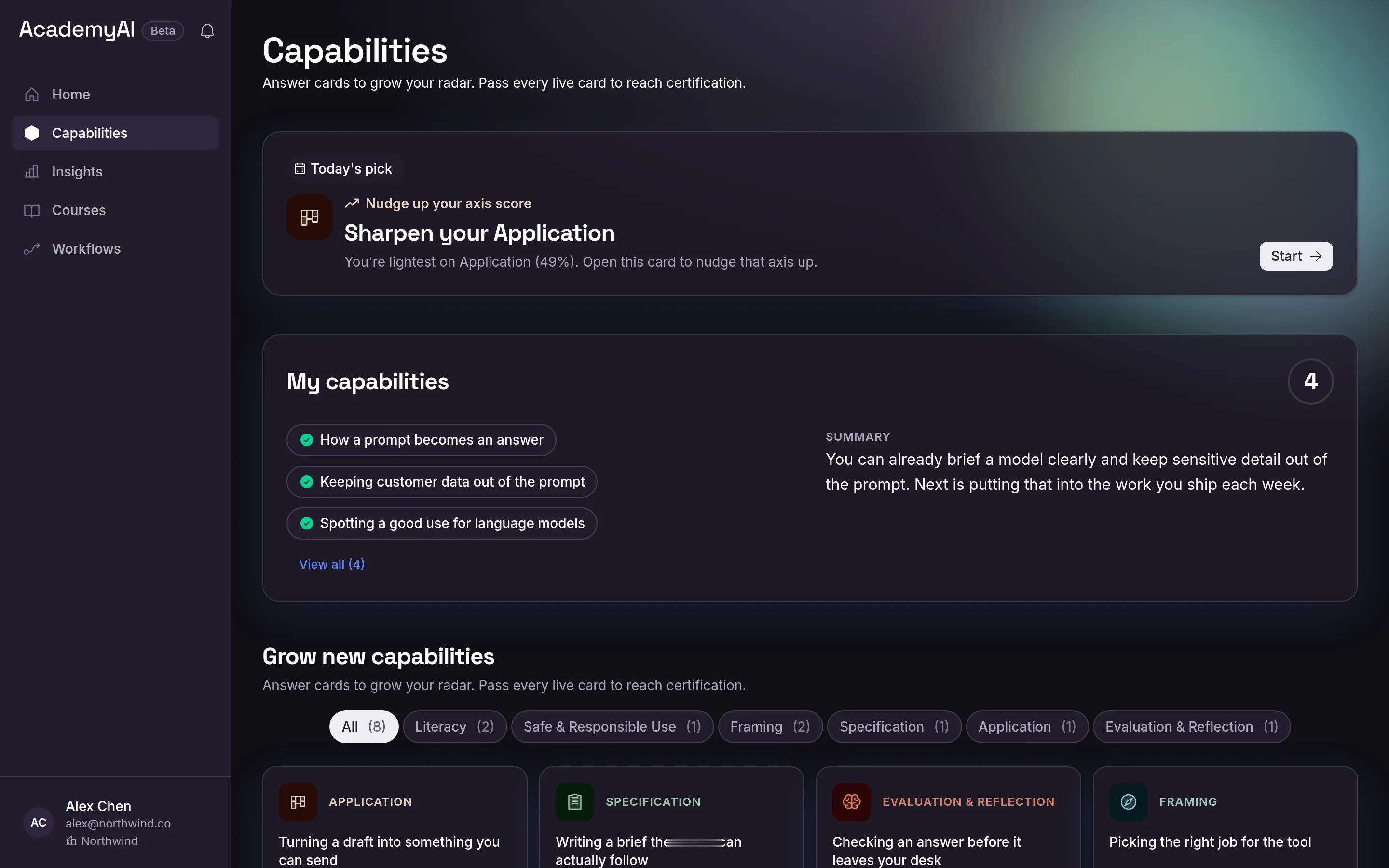
Capabilities
AcademyAI capability radar scoring a team on the six capabilities

Capability, measured in six.

Every role is scored on Literacy, Safe & Responsible Use, Framing, Specification, Application and Evaluation & Reflection. Works with ChatGPT, Copilot, Claude and Gemini.

  • Baseline every role with a short, scored assessment, not a usage report.
  • See gaps by team and role on one capability radar.
  • Re-assess and certify, so leadership sees what changed.
Questions

Building AI capability: common questions.

Something else? Talk to the team.

What is capability debt?

Darrell Fear describes capability debt as the gap between what strategy needs from people and what they can actually do. Some gap is normal. It becomes debt when a tool goes live without a shared view of what good use looks like. AI does not create it, but it speeds it up.

Why doesn't AI training lead to adoption?

Because completions and logins only show who took part. Training changes work when it is built around real roles and workflows, and when the conditions around people are in place: access, time, permission, guardrails, manager backing and relevant examples.

How do you assess AI skills before training?

Use realistic scenarios, not confidence surveys. Self-rated confidence measures how people feel about AI. A scenario shows what they would actually do, which tells you where to start and who needs what. AcademyAI scores every role across six capabilities before any training begins.

How should an AI academy be structured for different roles?

Group people by the work they do, not the tool they use. Instead of 30 or 40 entry points, Lloyds settled on four groups: everyday users, builders, leaders, and the people who make the work possible.

What should leaders answer before funding AI training?

Five questions: what business outcome or risk makes this urgent now, which roles and workflows need to change, what people need to do differently and to what standard, what conditions need to be in place, and what evidence will show it has worked.

Which AI tools does AcademyAI work with?

It is tool agnostic, with tracks for ChatGPT, Microsoft Copilot, Claude and Gemini. The judgement it trains works in any tool.

More from AI practitioners

Practitioner stories from people doing the work.

Sources

  1. Andy Lambert, The hidden gap slowing your AI rollout: what Lloyds learned building AI skills for 67,000 people, AcademyAI
  2. Capability Loop Podcast, with Darrell Fear, founder of Adoptive Learning Consultancy and formerly of Lloyds Banking Group, https://www.youtube.com/watch?v=fIkbjtXwuBo
  3. Ashley M. Hughes, Stephanie Zajac, Amanda L. Woods and Eduardo Salas, The Role of Work Environment in Training Sustainment: A Meta-Analysis, Human Factors, 2020
Your next step

Close the gap between strategy and skill.

Get a capability radar for your organisation and a plan to build AI capability into roles, workflows and ownership.