TLDR
- Most organisations now have AI tools in place, yet day-to-day work has barely moved. The sticking point is almost always people.
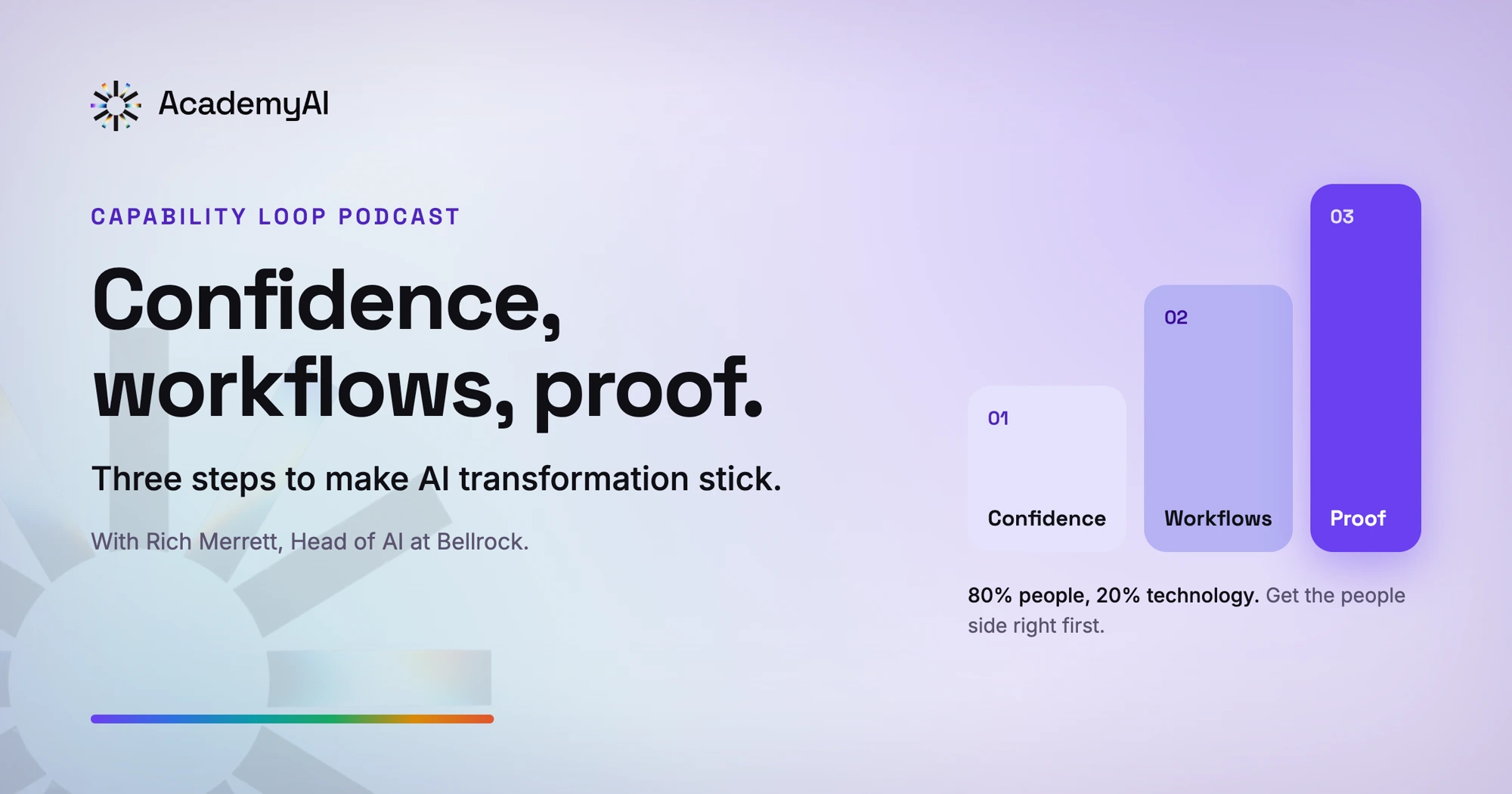
- Rich Merrett, Head of AI at Bellrock, puts the split at roughly 80% people and 20% technology, and has built his whole strategy around it.
- Programmes that stick get three things right: confidence, workflows and proof.
- Start with a policy that tells people what they can do, open several routes into AI at once, and keep checking the tools you've already built.
Visit most organisations a year after their AI launch and you'll find the same thing - licences are live, there's an acceptable use policy and the launch session was well attended. Then you ask how a typical team's work has actually changed and it goes very quiet.
We speak to HR, L&D and transformation leaders almost every week and hear the same thing over and over again - the technology has arrived, but the way people work mostly hasn't.
On our latest Capability Loop podcast episode, Rich Merrett, Head of AI at Bellrock, described AI as roughly 80% a people challenge and 20% a technology one. Organisations might get to grips with the tech but if they misjudge the people side, the ROI just isn't there.
And he has the proof points - at his previous employer, Citation, a sales tool his teams built brought in a quarter of a million pounds in its first four weeks and went on to win a National AI Award for innovation in 2025. (Source: Capability Loop Podcast)
Rich has transferred these learnings to Bellrock, where he runs a four-pillar strategy covering governance, people, solutions and monitoring. Looking at it from the outside, we think those pillars line up neatly with three conditions we see in every AI programme that has impact.
Three conditions for AI that deliver ROI
- Confidence. People know what they're allowed to do and feel safe trying it.
- Workflows. AI is built into real tasks, so new habits carry on after the launch buzz fades.
- Proof. Someone measures what has changed, and keeps measuring.
Most organisations have one of these, sometimes two. Here's how Bellrock covers all three.
Confidence begins with permission
Rich's governance starts from a simple position - that a clear AI policy should spell out what people can do. In his experience, a lot of AI policies are really security documents with a new title.
Bellrock uses four tiers within their governance. The lowest covers personal productivity, such as brainstorming or drafting something that contains no company information or personal data. The higher tiers need a risk assessment, and Rich has made those take 15 to 20 minutes on purpose, so anyone deploying something serious has had to think it through. (Source: Capability Loop Podcast)
His reasoning is purely pragmatic - physically blocking tools doesn't stop people using AI, because everyone has a phone and a personal laptop. Offering sanctioned access, even if it's limited to brainstorming on free tools, gives the business a foundation it can add controls to later.
For teams starting out, he suggests agreeing the organisation's risk appetite first, then deciding how many tiers are needed and what belongs in each. A small governance group helps, since the data protection officer's view of risk can differ sharply from the rest of the business - his own groups have brought together the DPO, CISO, CTO and legal lead.
Learning brings the next step of confidence. Every nine months Rich runs a week of optional half-hour lunchtime sessions, open to everyone. They move from what AI is, to how he uses it at home, to the tools and rules at Bellrock, then a hands-on day, and finish with colleagues showing what they've built without being experts. The home session matters more than it sounds. Jobs vary across a business, but most people relate to an assistant that pulls three school apps into one family calendar.
Confidence also means dealing with doubts openly. Some people resist AI for reasons worth respecting, such as its environmental cost or decades of doing a job one way. Rich raises those objections himself before anyone else can, including a slide on hallucinations and a section on sustainability. He's candid that AI can make people lazy in places but it's about making the right judgement call - he's happy for it to handle school admin but won't let it read an output for him.
Workflows turn interest into change
Training gets people curious, but workflows are where that curiosity becomes a different way of working, and Bellrock runs several routes at the same time.
Leadership workshops show managers how to spot use cases, estimate the return and reassure their teams that AI will change their jobs without replacing them. Build days, which Rich renamed Art of the Possible-athons after finance grew wary of the word hacking, give small teams a real problem and send them back to their desks with something usable the next morning.
Then there are the champions. They volunteer, get an immersive day away from the business, monthly check-ins, their own Teams channel, sessions with major technology vendors and a spotlight in a fortnightly AI newsletter. Bellrock now has 71 of them. (Source: Capability Loop Podcast)
Access to tools follows the same logic - rather than giving everyone one product, Rich matches access to role and skill level, because different tools suit different work. Anyone wanting more submits a request with a use case, and he reviews each one. When he can't approve a request, he shows the person what they could already do with the tools they have.
Those requests, along with a Teams chatbot for ideas and questions, feed a pipeline of hundreds of ideas that the whole business can see. Each one is scored for impact, strategic fit, time to value and reach, weighed against effort. Ideas then fall into three groups: quick wins people can now solve themselves, feasibility sprints the team can deliver in 10 days, and larger transformation projects tied to a measurable effect on EBITDA.
This is what we mean when we talk about taking AI from single player to multiplayer. One enthusiastic person with a clever prompt helps one person, but shared build days, a visible pipeline and a champions network let the whole organisation learn from each other. Leadership pushes from the top, champions pull from within teams, and build days create something in between. Rich admits that running all of it at once is busy - it's also why it works.
Proof points keep the gains from disappearing
Rich learned the value of monitoring the hard way. When OpenAI retired GPT-4, he didn't have enough time to migrate and retest everything that depended on it.
Now every AI solution is checked against the return predicted at the start, every quarter. He tracks model drift with tools such as Langfuse, and every six months he brings subject matter experts back to retest, either because a model is being retired or because a newer one does the job better for less.
That's a real shift from traditional software. A deterministic system, once shipped and patched, keeps doing the same thing. A system built on a probabilistic model needs ongoing attention from the people who understand the work.
Proof applies to people as well as tools. Rich is introducing 12 levels of AI capability, each with a badge, so anyone can see who has trained others and who to ask for help. He's sceptical of the phrase AI fluency, which now appears in almost every job description - saying you can use ChatGPT, in his view, tells an employer about as much as listing Excel on a CV.
The skill he values most is careful reading. A consultant can photograph a site and let AI draft the report, but their name still goes on it, so someone has to read it properly and decide whether they will put their name to it. Skip that step and you get a strange loop where one person turns notes into a polished AI document. The recipient lacks the time to read it and asks AI to shrink it back into notes. We see the same pattern in organisations we work with: managers become the bottleneck, reviewing confident-sounding documents and finding errors, which means the time saved earlier disappears.
Which is why we think the most valuable AI skills are human ones. Knowing what to trust, choosing which opportunities to pursue, seeing how pieces of work connect, and having the agency to act all need regular practice - keeping the human in the loop is vital.
Where to start
Go back to the three conditions and run a quick check.
- Confidence. Ask five colleagues what they're allowed to use AI for. If you get five different answers, start with the policy.
- Workflows. Count how many AI ideas from the last quarter were picked up by a team other than the one that had them. If the answer is close to zero, your AI use is still single player.
- Proof. Name the person responsible for retesting each AI tool your business already relies on. If nobody comes to mind, that's your first gap.
Bellrock shows what it looks like when all three conditions are in place and working - confidence gets people started, workflows keep them going, and proof shows leadership the effort was worth it.
You can build all of this in-house, and Bellrock is proof that it can be done. If you'd like support, AcademyAI assesses each person's AI capability before training begins, designs role-specific learning around real workflows, and measures the change in the work itself. See how we help organisations build AI capability.
Which of the three, confidence, workflows or proof, is weakest in your organisation right now? We'd love to hear what has worked for you and what hasn't.
You can hear the full conversation with Rich on the Capability Loop Podcast.
Sources
- Capability Loop Podcast, "AI Is 80% People: The Four Pillars Behind Bellrock's AI Strategy", with Rich Merrett, Head of AI at Bellrock: https://www.youtube.com/watch?v=i08mbDn8ZuU