
AcademyAI
Solutions
  • For BusinessTurn AI access into AI outcomes.
  • For IndividualsMake AI a multiplier for your career.
  • For HRLead AI capability, with evidence at every step.
  • For MarketingSee who uses AI well, train the gaps, prove what changed.
Take the diagnostic
OrganisationsFor BusinessTurn AI access into AI outcomes.
ProfessionalsFor IndividualsMake AI a multiplier for your career.
People teamsFor HRLead AI capability, with evidence at every step.
Marketing teamsFor MarketingSee who uses AI well, train the gaps, prove what changed.
Resources
  • From AI adoption to AI enablement at InformaMoving from AI adoption to enablement by designing for the quiet 95%.
  • Confidence, workflows, proof: how Bellrock made AI transformation stickThree steps to make AI transformation stick, from a four tier policy to 71 champions.
  • From prompting to organisation wide agents in the NHS, one step at a timeScaling AI safely in a large, highly regulated public sector body.
  • Building AI skills for 67,000 people: what Lloyds learnedAn academy for 67,000 colleagues works only as one part of a wider adoption system.
All use casesAll guides
InformaFrom AI adoption to AI enablement at InformaMoving from AI adoption to enablement by designing for the quiet 95%.
BellrockConfidence, workflows, proof: how Bellrock made AI transformation stickThree steps to make AI transformation stick, from a four tier policy to 71 champions.
NHSFrom prompting to organisation wide agents in the NHS, one step at a timeScaling AI safely in a large, highly regulated public sector body.
LloydsBuilding AI skills for 67,000 people: what Lloyds learnedAn academy for 67,000 colleagues works only as one part of a wider adoption system.
AI Capability ModelPricingPartnersBlog
DashboardSign inSign up
AcademyAI
SolutionsFor BusinessFor IndividualsFor HRFor MarketingResources
  • Informa
  • Bellrock
  • NHS
  • Lloyds
  • All practitioner stories
  • How to measure the ROI of AI
  • HR leader's guide to AI transformation
  • All guides
AI Capability ModelPricingPartnersBlog
New here?Start freeWelcome backOpen your dashboardI have an account
AcademyAI

One platform to learn, discover, build and prove.

Sign inStart for freeDashboard
Solutions
For BusinessFor IndividualsFor HRFor MarketingPricingAI Capability ModelExperts
Platform
Take the assessmentSee Where You StandAcademyAI vs MindstoneAcademyAI vs MultiverseAcademyAI vs Pair.aiAcademyAI vs Section AI
Resources
BlogPractitioner storiesGuidesChangelog
Company
AboutPressCareersPartnersContact
© 2026 AcademyAI. All rights reserved.
PrivacyTermsSecurity
AcademyAI
Solutions
  • For BusinessTurn AI access into AI outcomes.
  • For IndividualsMake AI a multiplier for your career.
  • For HRLead AI capability, with evidence at every step.
  • For MarketingSee who uses AI well, train the gaps, prove what changed.
Take the diagnostic
OrganisationsFor BusinessTurn AI access into AI outcomes.
ProfessionalsFor IndividualsMake AI a multiplier for your career.
People teamsFor HRLead AI capability, with evidence at every step.
Marketing teamsFor MarketingSee who uses AI well, train the gaps, prove what changed.
Resources
  • From AI adoption to AI enablement at InformaMoving from AI adoption to enablement by designing for the quiet 95%.
  • Confidence, workflows, proof: how Bellrock made AI transformation stickThree steps to make AI transformation stick, from a four tier policy to 71 champions.
  • From prompting to organisation wide agents in the NHS, one step at a timeScaling AI safely in a large, highly regulated public sector body.
  • Building AI skills for 67,000 people: what Lloyds learnedAn academy for 67,000 colleagues works only as one part of a wider adoption system.
All use casesAll guides
InformaFrom AI adoption to AI enablement at InformaMoving from AI adoption to enablement by designing for the quiet 95%.
BellrockConfidence, workflows, proof: how Bellrock made AI transformation stickThree steps to make AI transformation stick, from a four tier policy to 71 champions.
NHSFrom prompting to organisation wide agents in the NHS, one step at a timeScaling AI safely in a large, highly regulated public sector body.
LloydsBuilding AI skills for 67,000 people: what Lloyds learnedAn academy for 67,000 colleagues works only as one part of a wider adoption system.
AI Capability ModelPricingPartnersBlog
DashboardSign inSign up
AcademyAI
SolutionsFor BusinessFor IndividualsFor HRFor MarketingResources
  • Informa
  • Bellrock
  • NHS
  • Lloyds
  • All practitioner stories
  • How to measure the ROI of AI
  • HR leader's guide to AI transformation
  • All guides
AI Capability ModelPricingPartnersBlog
New here?Start freeWelcome backOpen your dashboardI have an account

Capability Loop·Opinion·25 November 2026·9 min read

PokerStars grew AI capability by invitation

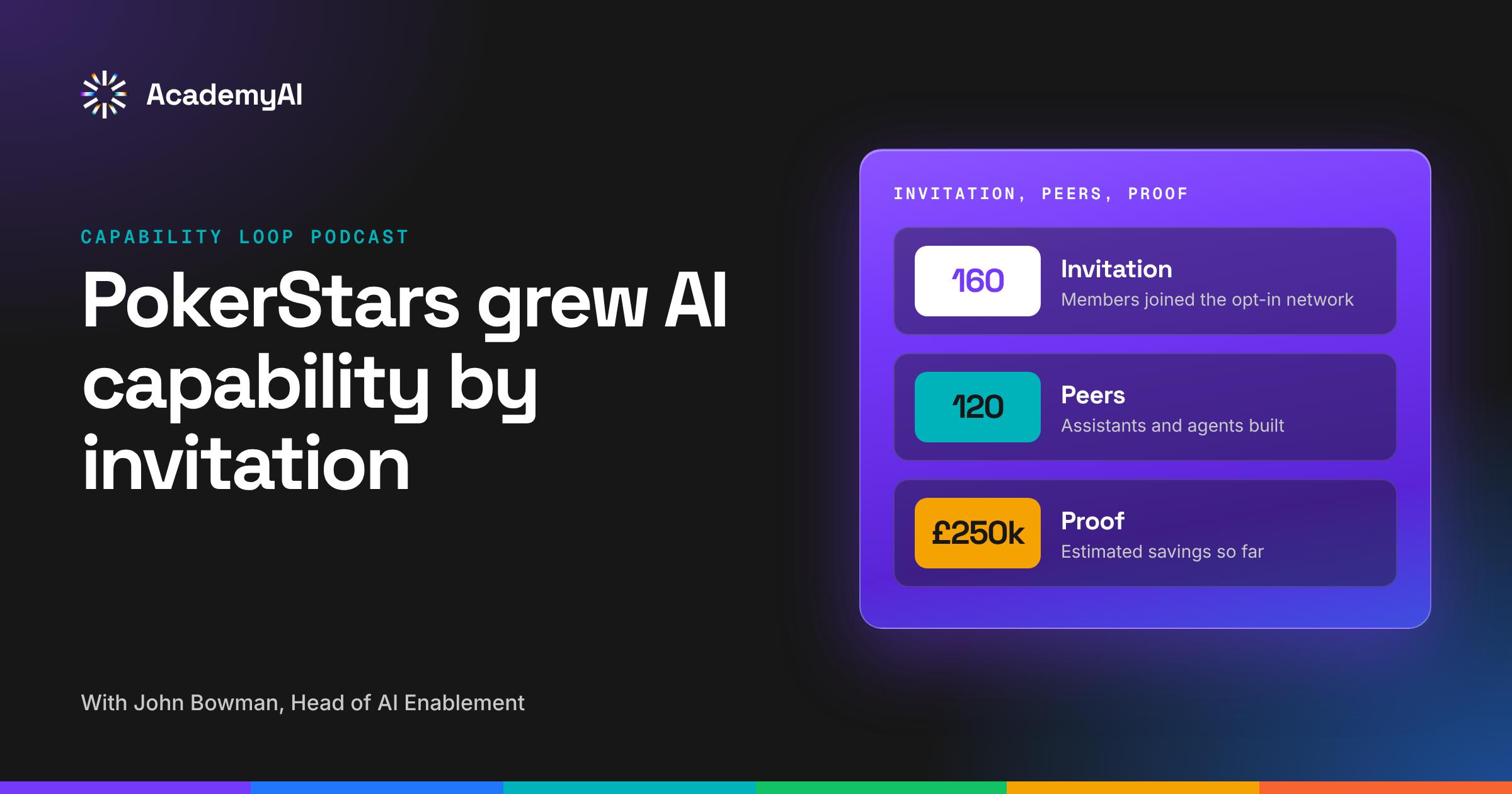
PokerStars kept the programme optional and still logged about 160 members, roughly 120 assistants and about £250k in estimated savings. Invitation, peers and proof hold it together.

Andy LambertCo-founder, AcademyAI
Contents

Contents00 / 08

  1. 01Why PokerStars made AI optional
  2. 02Colleagues make the best teachers
  3. 03Workshops that start with safety and end with something built
  4. 04One platform and protected time to learn it
  5. 05Counting skills, tools and hours saved
  6. 06Someone has to own AI
  7. 07Invitation, peers and proof
  8. 08Sources
Share
Share on LinkedIn

Find out where your team stands.

Take the assessment
TL;DR
  • AI capability at the organisation rests on three core principles: invitation, peers and proof.
  • PokerStars runs an opt-in AI network where around 160 members have built roughly 120 assistants and agents, with about 200 more ideas waiting to be ranked.
  • Peer learning does most of the work, with a weekly drop-in that connects people to colleagues in similar roles who have already solved their problem.
  • Every tool is logged, scored and given an estimated time saving, which puts the network at around £250k in savings so far.
  • Two questions remain open: who owns AI, and what happens when someone automates their own job. Both need answers from the top.
Dark AcademyAI podcast header titled PokerStars grew AI capability by invitation, with a byline for John Bowman and a purple panel showing 160 members, 120 assistants and £250k estimated savings.

Most of the AI programmes we come across begin with a mandate, usually a licence rollout, a compulsory course and a usage target. PokerStars, the global online poker platform, has taken a very different route, and the results are impressive.

On a recent episode of the Capability Loop Podcast, our co-founder Andy Lambert spoke to John Bowman, Head of AI Enablement at the platform. For the last six or seven months he has worked through the business one department at a time, mapping workflows and looking for places where AI and automation can take repetitive work off people's plates. Outside his day job he runs AI SAT, a community of AI builders he started in May that has grown to around 450 members. (Source: Capability Loop Podcast)

John's approach to ensuring AI capability across his organisation rests on three core principles, which we'll call invitation, peers and proof. People choose to take part, colleagues teach one another, and everything that gets built is counted. Very little of this depends on the size of the company or the tools it chooses to use, which is why we think it's useful learning for all types of organisations.

Why PokerStars made AI optional

John's view is that nobody should be made to learn AI, although he's happy to nudge people towards giving it a go. Anyone curious can join the AI network, which lives in a Slack channel stocked with guides, training videos and slides. Each week members can submit an agent, an assistant or simply an idea, and the leadership team awards prizes for the best of them. One winner came away with a trip to the AI summit in Amsterdam.

The numbers suggest this open-door approach works. Around 160 people have joined the network, and between them they've built something like 120 assistants and agents. Roughly 200 further ideas are in the queue, and John's team ranks them by time saved and likely impact on ROI before building the strongest ones alongside the teams that suggested them.

John is candid about the limits of an invitation approach. Some colleagues simply aren't interested, whether it's because they have no time, worry about what AI means for their role or have concerns about its environmental impact. He lets them carry on as they are and puts his energy into the people who want to learn.

Colleagues make the best teachers

If we were copying one part of the network, it would be the weekly drop-in. It runs for an hour and members bring along whatever they're stuck on. John told us he often says very little during these sessions, because another member in a similar role has usually solved the same problem already and is glad to walk everyone through it.

Getting the experts to take the lead is important, as John admits that the work of some departments is hard for him to follow in detail, and no central AI lead can be an expert in every function. Much of the network's value comes from putting people in touch with a colleague who understands their work and has already found something that helps.

Workshops that start with safety and end with something built

Alongside the network, John runs workshops for departments that ask for them. These teams have mostly stayed out of the network because they haven't had time for training, so the workshop is often their first proper contact with the tools. Each session opens with around 20 minutes on security and data, moves on to a tour of the interface and how to set up assistants, and then gives people an hour to build something for their own job.

The safety section is a really important starting point. When John started building out the AI capability of the organisation, plenty of people were uploading files to ChatGPT, which isn't a company tool, and IT and InfoSec now show a warning whenever anyone tries.

The building hour is where the confidence comes from. The live events team, whose work is mostly face to face, left with assistants they were proud of, and a few had vibe-coded small tools of their own, such as a clock showing the local time for each colleague.

One platform and protected time to learn it

Copilot and Claude are now the approved tools at PokerStars. Five or six hundred people, roughly 10% of colleagues, are using Claude and Claude Code, and everyone is due to get access from February next year. John's firm view is that a large business should commit fully to one tool and train everyone on it. Enthusiasts enjoy hopping between platforms, yet for most colleagues every switch means relearning something they had only just got comfortable with.

Time is the other constraint, and redundancies across his industry have left many people covering extra work. John suggests treating learning the way companies already treat holidays. The business keeps running when people are on leave, so it can keep running while the people who want to learn spend two protected hours a week improving their skills.

Counting skills, tools and hours saved

This is where the third principle, proof, comes in. Before rolling anything out, PokerStars surveyed everyone's skills and found that around 90% of people had never built an assistant, with most using AI much as they would use Google. The survey runs again in December, which will give the business a before-and-after view of capability.

Every tool that gets built is logged and privately scored. That lets John spot when two teams have made something similar and point one of them towards the stronger version, which cuts down on the duplicated effort we see in so many organisations. Each tool also carries an estimated time saving, and multiplying the total by an average hourly salary puts the network at around £250k in savings so far.

John is careful about what happens to those hours. He doesn't want them simply refilled with more of the same work, and would prefer they went on things businesses rarely find time for, such as reviewing what worked after a big promotion. Targets can rise, he thinks, as long as they do so gradually, having watched developers' targets quadruple once AI made them faster. In our experience, hours saved is the easiest figure to capture. The larger gains, like a salesperson spending more time with customers, are harder to connect to results, and that is the measurement work most businesses still have ahead of them.

Someone has to own AI

John compares AI to websites, which once had a single webmaster and are now pulled between SEO, technology, compliance and data teams. He doesn't think AI belongs under IT or compliance, and argues that at this stage a business needs an AI webmaster to guide everyone. At PokerStars, AI features on the roadmap and in people's goals, yet ownership is still spread across the business.

The harder question is what happens when someone automates their own role. A colleague recently showed John a SharePoint web app he'd built, with dashboards replacing his old spreadsheets, and said that improving it any further would more or less replace his job. John believes that conversation has to be led from the top. As we see it, 2025 was the year businesses bought the tools and 2026 is the year they are implementing them, which makes 2027 the year those difficult questions need to be answered.

Invitation, peers and proof

Looking back over the conversation, those three principles hold the whole programme together. Invitation brings in the people who want to learn and gives them a reason to share what they build. Peers spread that knowledge faster than any central team could manage alone. Proof, through a skills survey, a scored log of tools and estimated hours saved, shows leadership what the effort is worth.

John has built much of this by hand, and any organisation could do the same with a Slack channel, a survey tool and a spreadsheet. If you'd rather run it from a single platform, AcademyAI assesses skills gaps across your teams, closes them with role-specific microlearning, helps people build workflows for their own work and measures the whole journey, from the impact of learning to how work is changing and what that means for ROI. You can find out more about AcademyAI here.

The full conversation is on YouTube and the podcast feed.

Which of the three is strongest in your organisation today, and which would you need to build next?

Sources

  • Capability Loop Podcast with John Bowman, Head of AI Enablement at PokerStars, on YouTube and Buzzsprout
  • AI SAT (strategy, automation and transformation) community: aisat.uk
Tagged
enablementadoptionmeasurementPokerStars
Share this post
Share on LinkedIn
Written byAndy LambertCo-founder, AcademyAI

Writes about how organisations turn tool access into capability they can measure.

Related posts.

Every story so far
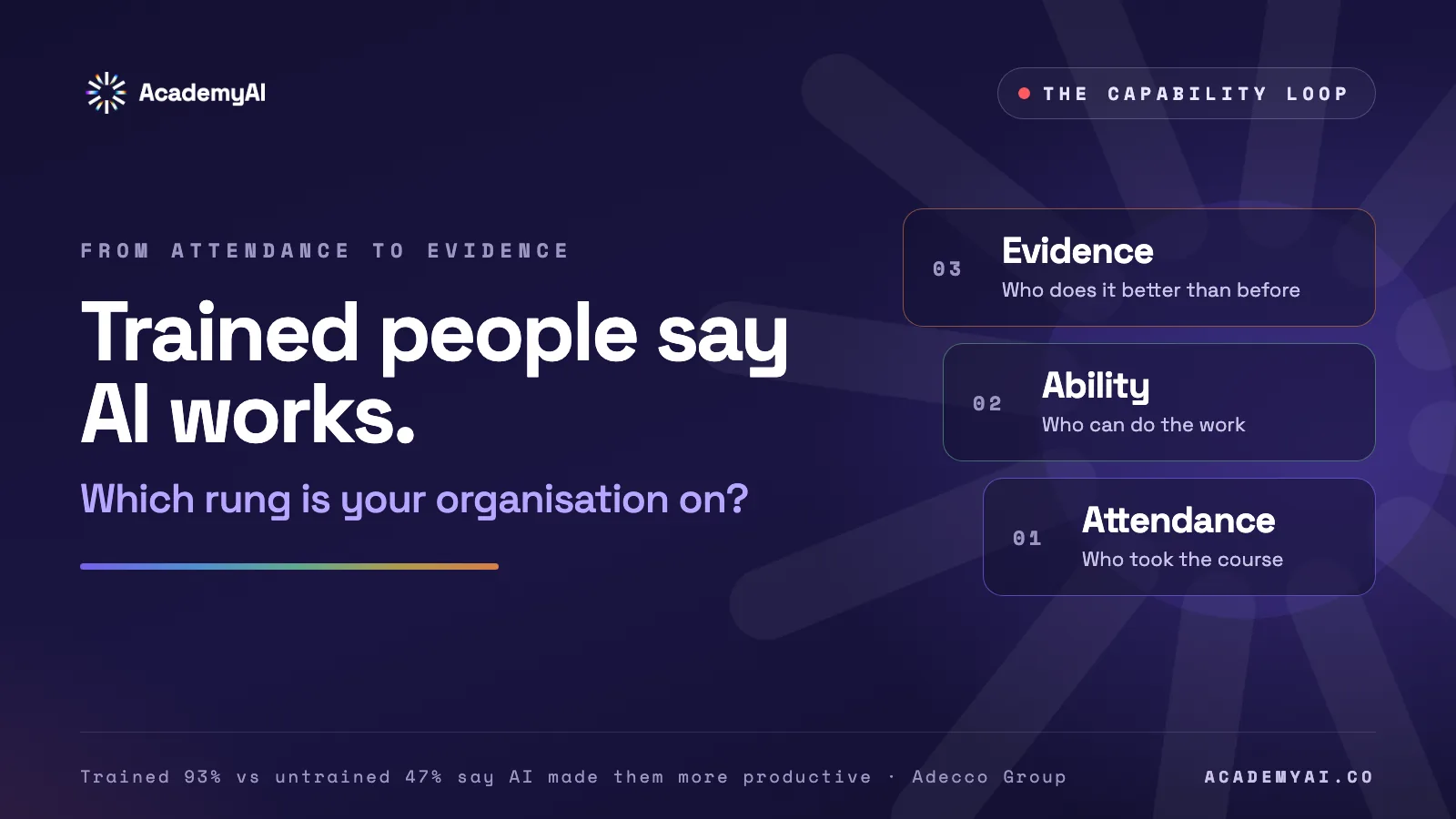
  • Dark purple AcademyAI header with the headline Trained people say AI works, the question Which rung is your organisation on, and three cards labelled Evidence, Ability and Attendance.training

    Most people trained in AI say it works. Can you prove it in your own organisation?

    In a study of 40,500 workers, trained people were far more likely to say they had become more productive. Most organisations can count completions. Very few can show the work is better.23 November 2026 · 5 min read
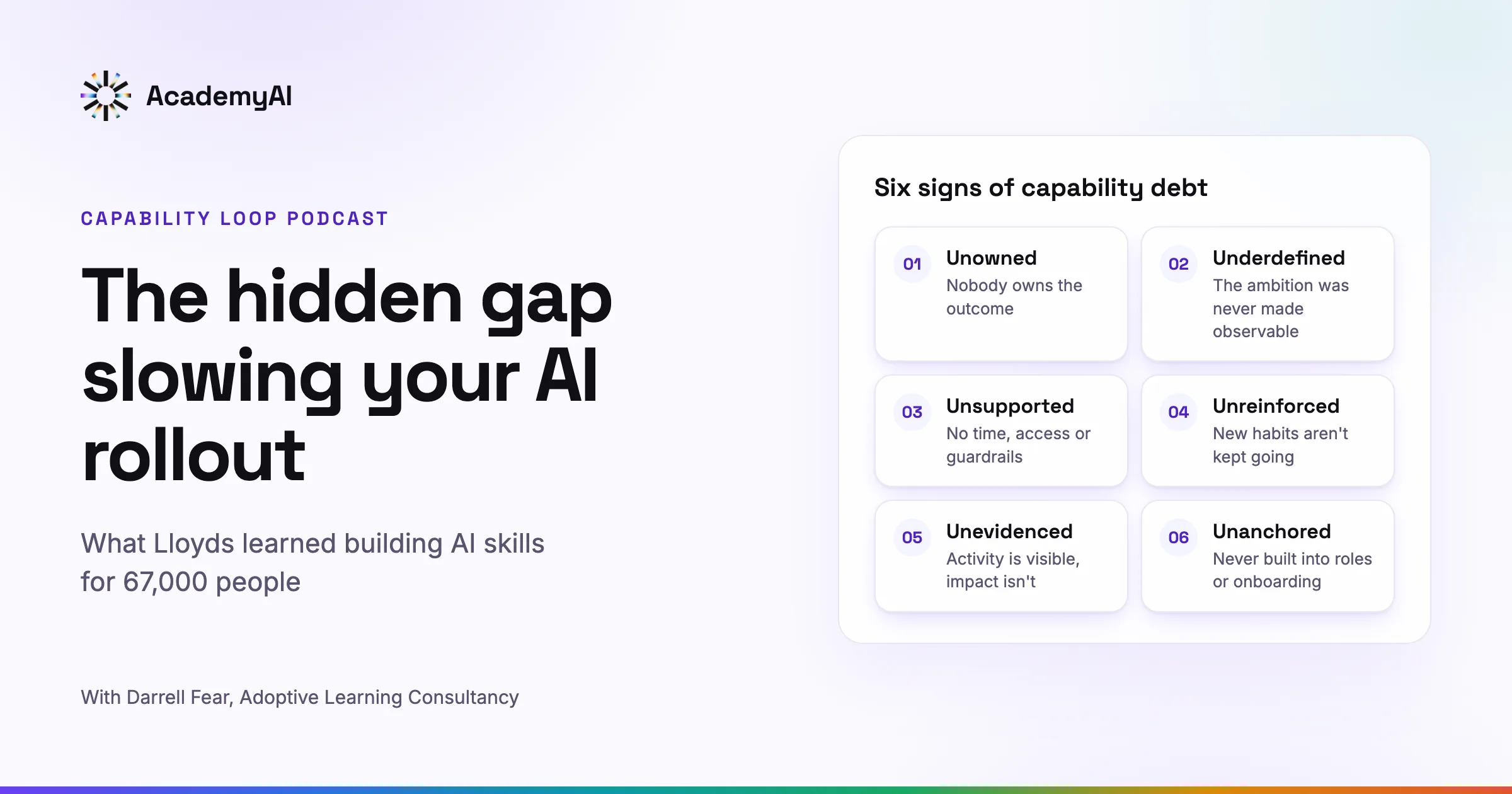
  • Pale lilac AcademyAI header for the Capability Loop Podcast. The headline reads The hidden gap slowing your AI rollout, with the subtitle What Lloyds learned building AI skills for 67,000 people and the byline With Darrell Fear, Adoptive Learning Consultancy. A card lists six signs of capability debt: Unowned, Underdefined, Unsupported, Unreinforced, Unevidenced and Unanchored. A thin multicolour bar runs along the bottom.AI capability

    The hidden gap slowing your AI rollout - what Lloyds learned building AI skills for 67,000 people

    Darrell Fear helped build the Lloyds academy for 67,000 colleagues. The lesson is that the academy only works as one part of a wider adoption system.19 November 2026 · 8 min read
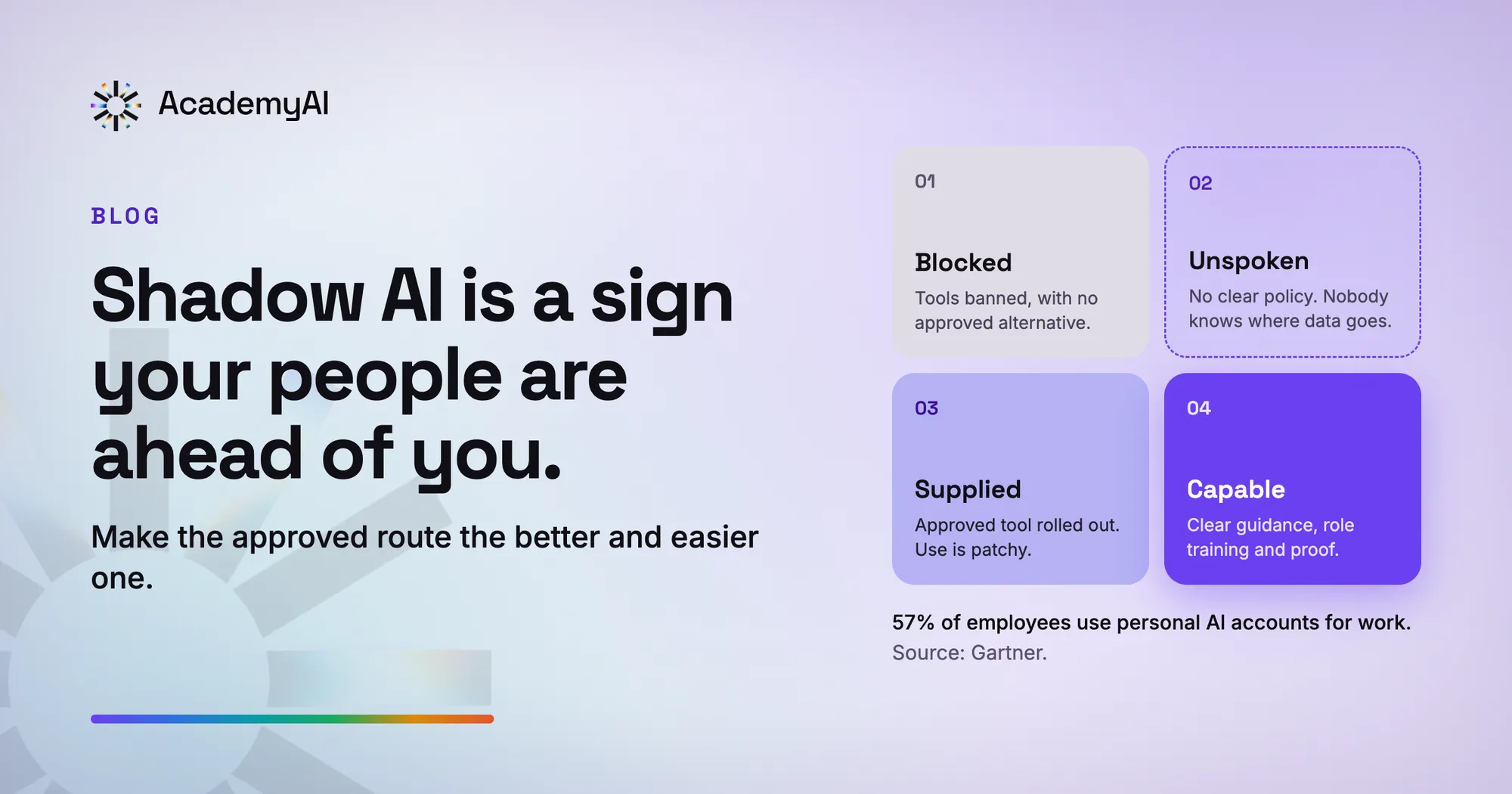
  • Pale lilac AcademyAI blog header with the title Shadow AI is a sign your people are ahead of you, four cards labelled Blocked, Unspoken, Supplied and Capable, and a line that 57% of employees use personal AI accounts for work.unapproved tools

    Shadow AI is a sign your people are ahead of you

    Unapproved tools are a sign people are already ahead of official provision. Most organisations we speak to sit at Unspoken or Supplied, and the work is to make the approved route easier.16 November 2026 · 8 min read
From reading to measuring

Find out where your team stands.

Reading helps. Measuring helps more. Take the assessment and see your team's capability across six measurements.

Take the assessment
AcademyAI

One platform to learn, discover, build and prove.

Sign inStart for freeDashboard
Solutions
For BusinessFor IndividualsFor HRFor MarketingPricingAI Capability ModelExperts
Platform
Take the assessmentSee Where You StandAcademyAI vs MindstoneAcademyAI vs MultiverseAcademyAI vs Pair.aiAcademyAI vs Section AI
Resources
BlogPractitioner storiesGuidesChangelog
Company
AboutPressCareersPartnersContact
© 2026 AcademyAI. All rights reserved.
PrivacyTermsSecurity