
AcademyAI
Solutions
  • For BusinessTurn AI access into AI outcomes.
  • For IndividualsMake AI a multiplier for your career.
  • For HRLead AI capability, with evidence at every step.
  • For MarketingSee who uses AI well, train the gaps, prove what changed.
Take the diagnostic
OrganisationsFor BusinessTurn AI access into AI outcomes.
ProfessionalsFor IndividualsMake AI a multiplier for your career.
People teamsFor HRLead AI capability, with evidence at every step.
Marketing teamsFor MarketingSee who uses AI well, train the gaps, prove what changed.
Resources
  • From AI adoption to AI enablement at InformaMoving from AI adoption to enablement by designing for the quiet 95%.
  • Confidence, workflows, proof: how Bellrock made AI transformation stickThree steps to make AI transformation stick, from a four tier policy to 71 champions.
  • From prompting to organisation wide agents in the NHS, one step at a timeScaling AI safely in a large, highly regulated public sector body.
  • Building AI skills for 67,000 people: what Lloyds learnedAn academy for 67,000 colleagues works only as one part of a wider adoption system.
All use casesAll guides
InformaFrom AI adoption to AI enablement at InformaMoving from AI adoption to enablement by designing for the quiet 95%.
BellrockConfidence, workflows, proof: how Bellrock made AI transformation stickThree steps to make AI transformation stick, from a four tier policy to 71 champions.
NHSFrom prompting to organisation wide agents in the NHS, one step at a timeScaling AI safely in a large, highly regulated public sector body.
LloydsBuilding AI skills for 67,000 people: what Lloyds learnedAn academy for 67,000 colleagues works only as one part of a wider adoption system.
AI Capability ModelPricingPartnersBlog
DashboardSign inSign up
AcademyAI
SolutionsFor BusinessFor IndividualsFor HRFor MarketingResources
  • Informa
  • Bellrock
  • NHS
  • Lloyds
  • All practitioner stories
  • How to measure the ROI of AI
  • HR leader's guide to AI transformation
  • All guides
AI Capability ModelPricingPartnersBlog
New here?Start freeWelcome backOpen your dashboardI have an account
AcademyAI

One platform to learn, discover, build and prove.

Sign inStart for freeDashboard
Solutions
For BusinessFor IndividualsFor HRFor MarketingPricingAI Capability ModelExperts
Platform
Take the assessmentSee Where You StandAcademyAI vs MindstoneAcademyAI vs MultiverseAcademyAI vs Pair.aiAcademyAI vs Section AI
Resources
BlogPractitioner storiesGuidesChangelog
Company
AboutPressCareersPartnersContact
© 2026 AcademyAI. All rights reserved.
PrivacyTermsSecurity
AcademyAI
Solutions
  • For BusinessTurn AI access into AI outcomes.
  • For IndividualsMake AI a multiplier for your career.
  • For HRLead AI capability, with evidence at every step.
  • For MarketingSee who uses AI well, train the gaps, prove what changed.
Take the diagnostic
OrganisationsFor BusinessTurn AI access into AI outcomes.
ProfessionalsFor IndividualsMake AI a multiplier for your career.
People teamsFor HRLead AI capability, with evidence at every step.
Marketing teamsFor MarketingSee who uses AI well, train the gaps, prove what changed.
Resources
  • From AI adoption to AI enablement at InformaMoving from AI adoption to enablement by designing for the quiet 95%.
  • Confidence, workflows, proof: how Bellrock made AI transformation stickThree steps to make AI transformation stick, from a four tier policy to 71 champions.
  • From prompting to organisation wide agents in the NHS, one step at a timeScaling AI safely in a large, highly regulated public sector body.
  • Building AI skills for 67,000 people: what Lloyds learnedAn academy for 67,000 colleagues works only as one part of a wider adoption system.
All use casesAll guides
InformaFrom AI adoption to AI enablement at InformaMoving from AI adoption to enablement by designing for the quiet 95%.
BellrockConfidence, workflows, proof: how Bellrock made AI transformation stickThree steps to make AI transformation stick, from a four tier policy to 71 champions.
NHSFrom prompting to organisation wide agents in the NHS, one step at a timeScaling AI safely in a large, highly regulated public sector body.
LloydsBuilding AI skills for 67,000 people: what Lloyds learnedAn academy for 67,000 colleagues works only as one part of a wider adoption system.
AI Capability ModelPricingPartnersBlog
DashboardSign inSign up
AcademyAI
SolutionsFor BusinessFor IndividualsFor HRFor MarketingResources
  • Informa
  • Bellrock
  • NHS
  • Lloyds
  • All practitioner stories
  • How to measure the ROI of AI
  • HR leader's guide to AI transformation
  • All guides
AI Capability ModelPricingPartnersBlog
New here?Start freeWelcome backOpen your dashboardI have an account

Capability Loop·Opinion·23 November 2026·5 min read

Most people trained in AI say it works. Can you prove it in your own organisation?

In a study of 40,500 workers, trained people were far more likely to say they had become more productive. Most organisations can count completions. Very few can show the work is better.

Andy LambertCo-founder, AcademyAI
Contents

Contents00 / 03

  1. 01Attendance, ability, evidence
  2. 02Why Copilot training doesn't lead to adoption
  3. 03Where to start
Share
Share on LinkedIn

Find out where your team stands.

Take the assessment
TL;DR
  • Adecco Group's 2026 study of 40,500 workers found that 93% of trained AI users say it has made them more productive, against 47% of those without training.
  • AI training participation fell from 77% to 67% this year, even though 66% of workers say AI has changed the skills their job needs.
  • Most organisations can count course completions and usage. Very few can show that people are doing their work better.
  • We use a simple three-step ladder (attendance, ability, evidence) and four practical steps to help you work out where you are and move up.
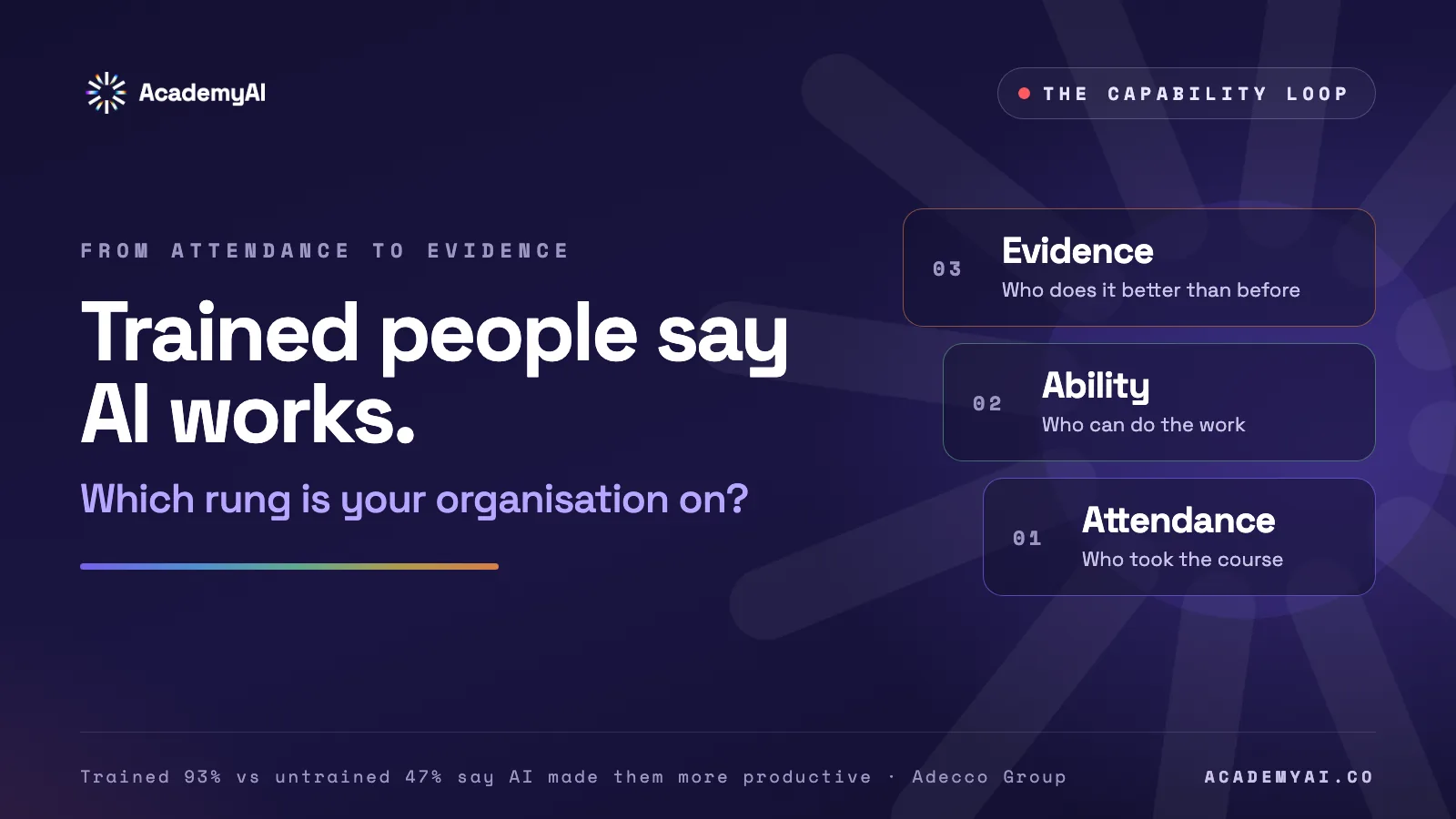
Dark purple AcademyAI header with the headline Trained people say AI works, the question Which rung is your organisation on, and three cards labelled Evidence, Ability and Attendance.

This week a head of AI delivery at a large Microsoft organisation told us they'd rolled out Copilot a couple of months ago. They could see so little of what had changed that they paid an outside firm to build a dashboard showing who was using what. We asked what they could see about capability and the honest answer was nothing.

We hear a version of this from most of the HR, L&D and AI leaders we talk to. Counting and measuring actual AI usage is relatively easy, but knowing whether anyone has got better at their job because of AI is much, much harder.

Adecco Group's new large-scale global study, out this week, shows why that matters. Surveying 40,500 workers in 36 countries, it showed that for people who use AI, 93% of those who'd been trained said it had made them more productive. Among those who hadn't been trained, it was 47%. (Source: Adecco Group)

The report asked two more critical questions, and the results tell a story of their own. 66% of workers think AI has changed the skills their job needs. Yet participation in AI training fell from 77% in 2025 to 67% this year. (Source: Adecco Group)

Writing in Fortune, Adecco's CEO Denis Machuel adds another figure. Workers who've completed AI training are 51 percentage points more likely to feel comfortable working alongside AI. (Source: Fortune)

Attendance, ability, evidence

When looking at AI adoption and proving ROI, we usually place organisations on a simple three-step ladder.

Attendance. You know who took the course. Completions go into a report, and the report goes to the board.

Ability. You know what people can actually do. You've assessed it, ideally before training, and you can see which roles or people are strong and which are thin.

Evidence. You can show the same people doing real work better than they did last quarter, and you can explain how you know.

Most organisations we work with start on the first step and want to reach the third. The head of AI delivery we quoted above has usage data and a dashboard, which puts them somewhere between attendance and ability.

They're not unusual. In General Assembly's new survey of 510 L&D leaders, 36% said course completions are one of their main measures of success. 26% said one of their biggest challenges is telling AI course completions apart from real competence. (Source: General Assembly)

Why Copilot training doesn't lead to adoption

We get asked this a lot, and Adecco's numbers help to add context to the question around adoption. Training is dropping off just as the skills are changing, and the people who missed the training first time around are much less sure AI actually helps them in their day-to-day work. A licence gives someone access, but it can't tell them how to optimise what they do on a Monday morning.

It's also why we here at AcademyAI don't put much weight on a completion rate. Anyone can finish a course, but that doesn't prove the work has changed.

Where to start

  1. Work out which step you're on. Be honest about whether you know who attended, who can do it, or who has actually improved.
  2. Get a baseline. Assess AI capability by role before the next round of training, so you know where each team starts.
  3. Ask one question twice. Use Adecco's wording, whether AI has made people more productive, before and after training. Compare trained and untrained groups.
  4. Look at the work. Pick two or three real tasks for each role and check whether they've improved. Self-reports tell you how people feel, but looking at the work itself shows you what has changed.

Step 4 is the hard part. We haven't yet met an organisation that has fully solved it, and it's where we spend most of our time with clients.

Most organisations are still at attendance, and the licences are already paid for. With fewer people getting trained, it's worth knowing which step you're on before the next budget conversation.

You can do all of this yourself with a survey tool, a spreadsheet and some patience. If you'd like help, we assess each person's AI capability before training starts, build role-specific learning into day-to-day work, and show the improvement in the work itself. See how it works at AcademyAI.

Which step is your organisation on, and what would it take to move up one?
Tagged
trainingmeasurementproductivityL&D
Share this post
Share on LinkedIn
Written byAndy LambertCo-founder, AcademyAI

Writes about how organisations turn tool access into capability they can measure.

Related posts.

Every story so far
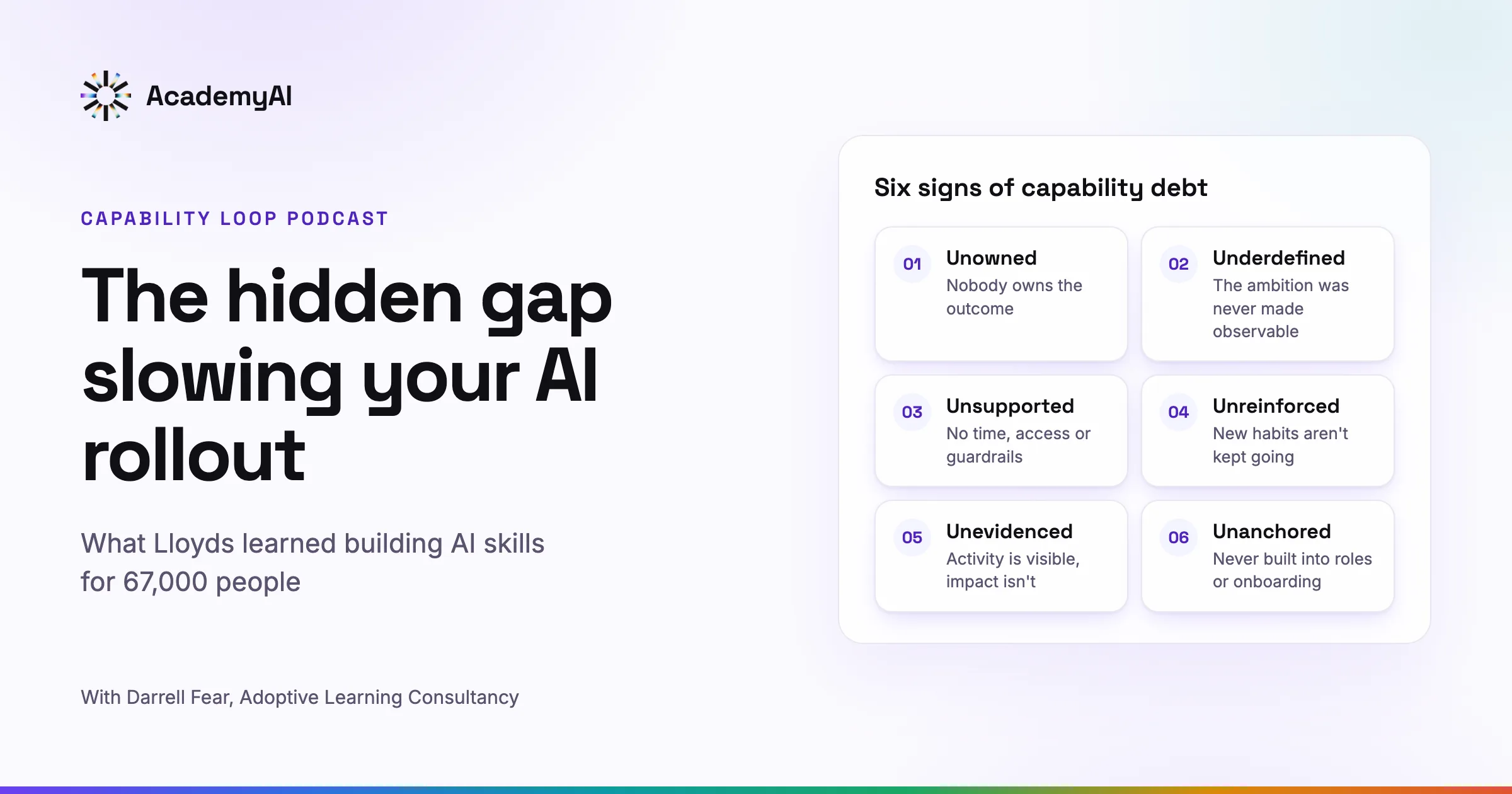
  • Pale lilac AcademyAI header for the Capability Loop Podcast. The headline reads The hidden gap slowing your AI rollout, with the subtitle What Lloyds learned building AI skills for 67,000 people and the byline With Darrell Fear, Adoptive Learning Consultancy. A card lists six signs of capability debt: Unowned, Underdefined, Unsupported, Unreinforced, Unevidenced and Unanchored. A thin multicolour bar runs along the bottom.AI capability

    The hidden gap slowing your AI rollout - what Lloyds learned building AI skills for 67,000 people

    Darrell Fear helped build the Lloyds academy for 67,000 colleagues. The lesson is that the academy only works as one part of a wider adoption system.19 November 2026 · 8 min read
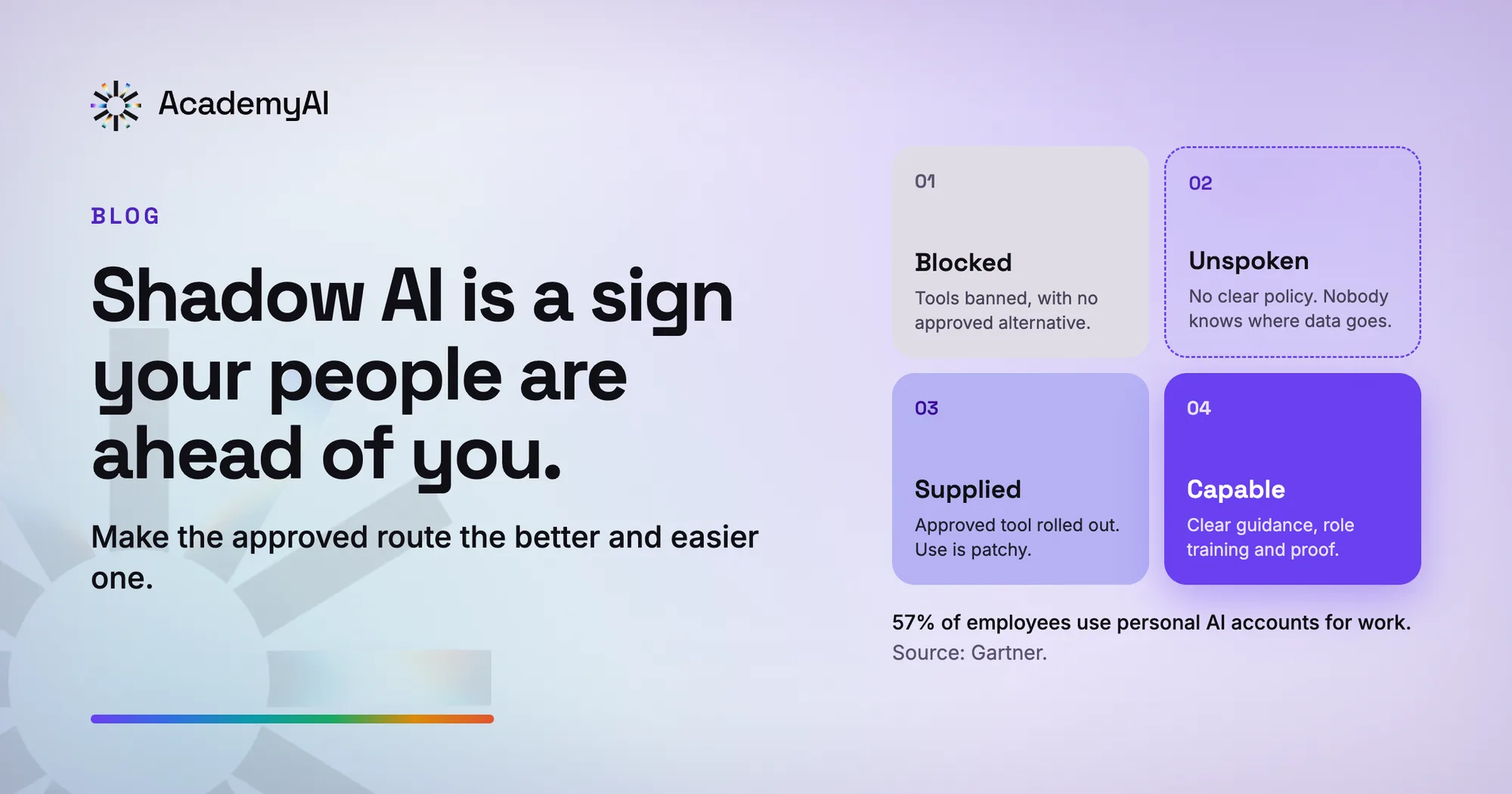
  • Pale lilac AcademyAI blog header with the title Shadow AI is a sign your people are ahead of you, four cards labelled Blocked, Unspoken, Supplied and Capable, and a line that 57% of employees use personal AI accounts for work.unapproved tools

    Shadow AI is a sign your people are ahead of you

    Unapproved tools are a sign people are already ahead of official provision. Most organisations we speak to sit at Unspoken or Supplied, and the work is to make the approved route easier.16 November 2026 · 8 min read
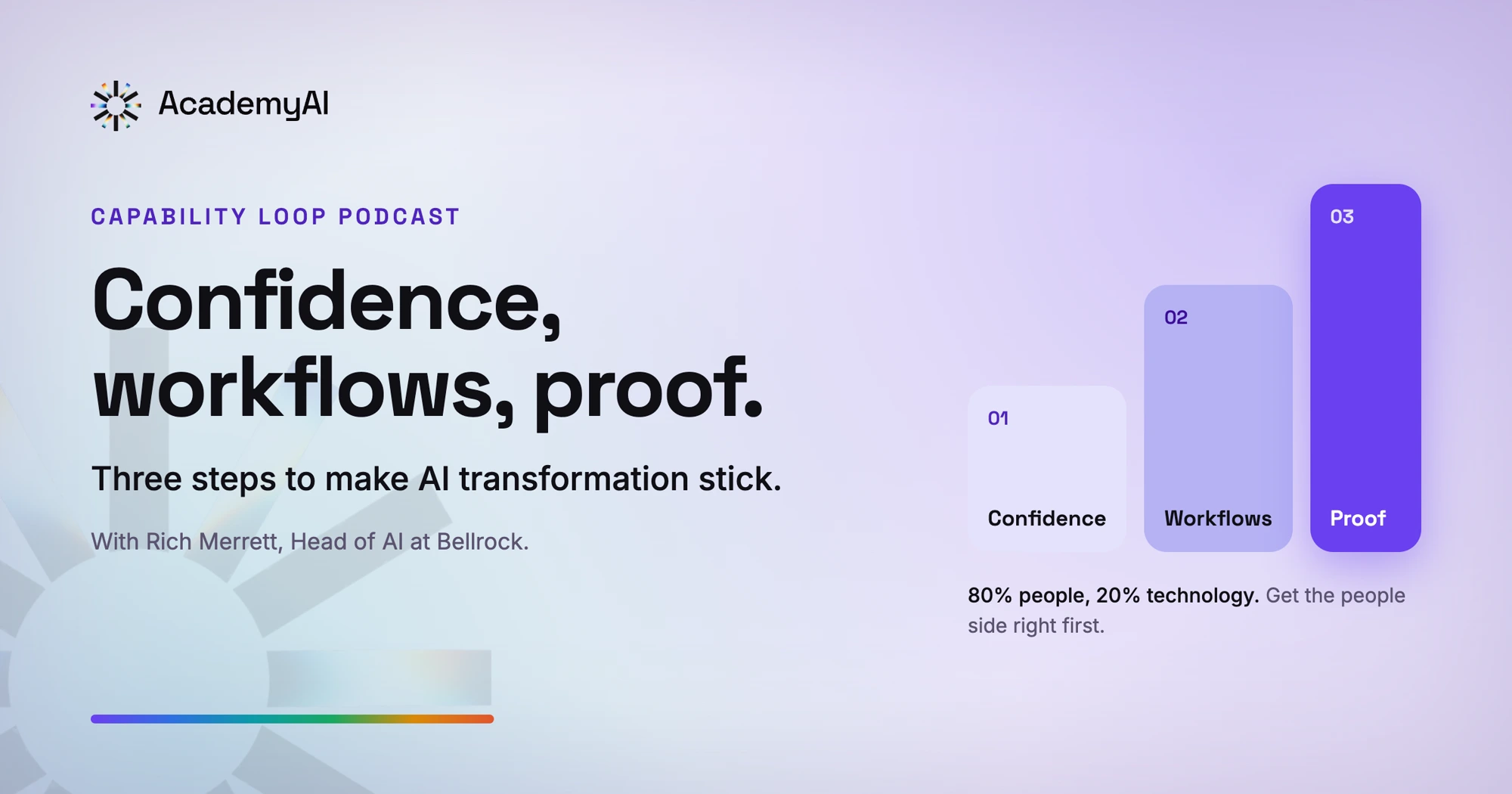
  • Pale lilac AcademyAI header with the headline Confidence, workflows, proof, the line Three steps to make AI transformation stick, the byline With Rich Merrett, Head of AI at Bellrock, and three rising bars labelled 01 Confidence, 02 Workflows and 03 Proof.AI capability

    Confidence, workflows, proof: three steps to make AI transformation stick

    A year on, the licences are live and the policy exists, but day-to-day work has barely moved. Confidence, workflows and proof are what make the programme stick.12 November 2026 · 9 min read
From reading to measuring

Find out where your team stands.

Reading helps. Measuring helps more. Take the assessment and see your team's capability across six measurements.

Take the assessment
AcademyAI

One platform to learn, discover, build and prove.

Sign inStart for freeDashboard
Solutions
For BusinessFor IndividualsFor HRFor MarketingPricingAI Capability ModelExperts
Platform
Take the assessmentSee Where You StandAcademyAI vs MindstoneAcademyAI vs MultiverseAcademyAI vs Pair.aiAcademyAI vs Section AI
Resources
BlogPractitioner storiesGuidesChangelog
Company
AboutPressCareersPartnersContact
© 2026 AcademyAI. All rights reserved.
PrivacyTermsSecurity