Most AI programme reports still lead with logins: active users, prompts sent, licences taken up. When we ask HR and L&D teams what has changed in the work itself, and what the benefits it - the silence tells its own story.
BCG's latest AI at Work survey found that regular AI use among frontline employees has stalled at 51%. (Source: BCG)
So when I sat down with Donna Lovitt-Edwards, Head of AI Fluency at Informa, on the Capability Loop Podcast, I wanted to hear how she is working to move beyond that number. Informa has around 15,000 permanent staff across 35 countries and Donna shared one of the most people-first accounts of AI transformation that I've heard.
Her approach comes down to four steps:
- Measure the work.
- Design for the quiet majority.
- Start with real problems.
- Give people freedom inside guardrails, with a clear home for AI.
Logins stop being useful quickly
Donna thinks usage numbers are fine early on, when you need some way to report progress, but after that they are purely a vanity measure. Someone who writes one really good prompt that saves an hour is worth more than someone logging in ten times a day for a summary.
So instead she talks about enablement. Are people saving time, producing better work, and handing off the repetitive parts of the job?
That's harder to measure, and Donna doesn't pretend otherwise. Her answer is to work with the people who own the numbers - if you save someone ten minutes on a daily task, that adds up to 50 minutes a week. Ask finance for an hourly cost for that team and you can quantify the ROI.
The best example came from a sales lead whose only question was whether sales would go up. They agreed a realistic target of a 3% increase in conversions. Marketing used AI to write three versions of copy for A/B/C testing and followed each one through the pipeline. Two months in, conversions were up 2%, which for Informa runs into millions of pounds. (Source: Capability Loop Podcast)
Does anyone in your finance team know what your AI programme is meant to deliver? If not, logins are probably still doing the reporting, and they won't survive the next budget round.
Most AI programmes are built for the enthusiasts
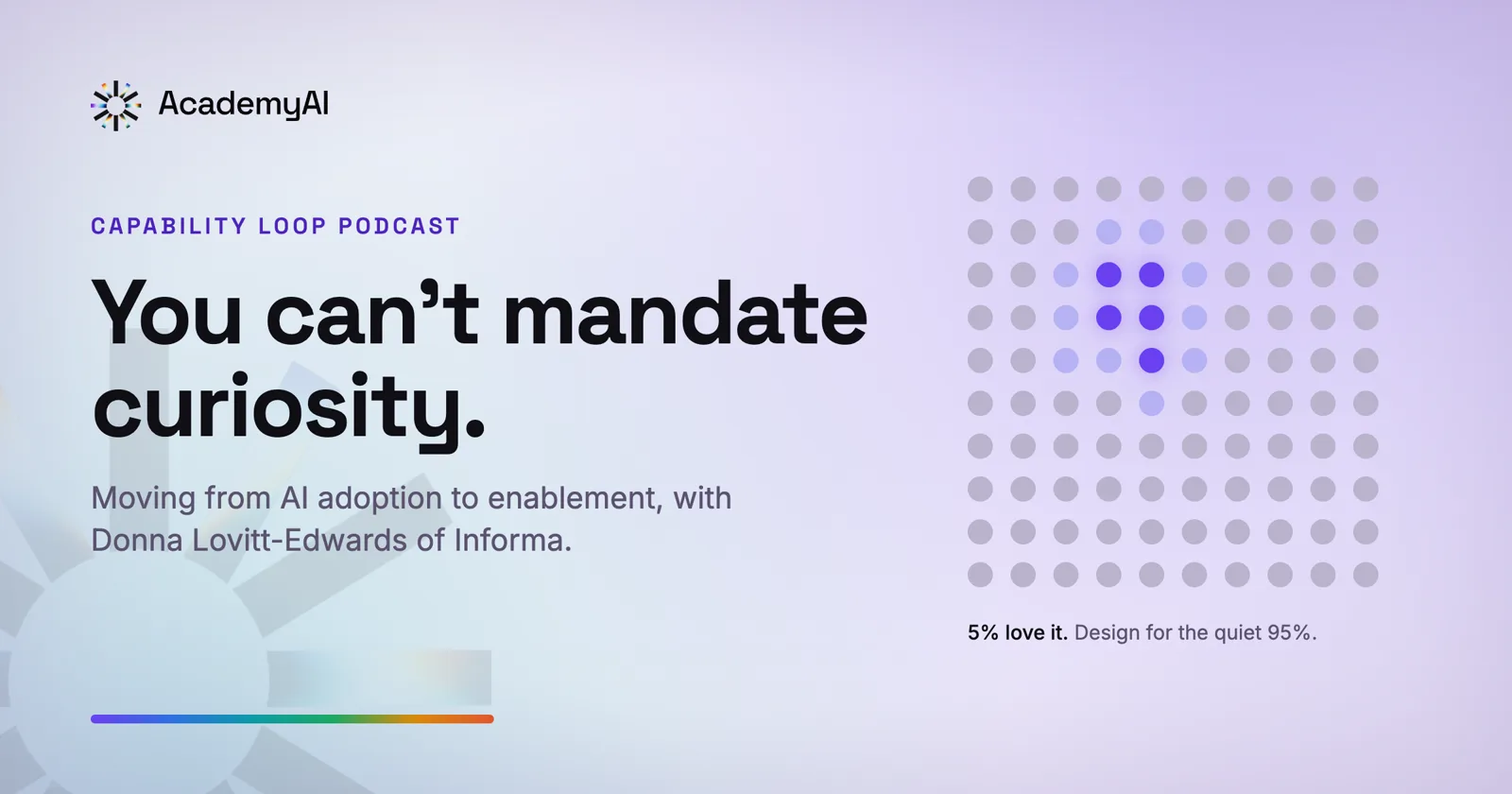
Donna thinks mandating AI use is a mistake, and she admits that ten years ago she'd have mandated everything herself. Working with Informa's change managers changed her mind.
When people are told to use AI, they use it in the most basic way and stop. She talks about how businesses need to create moments of curiosity instead, like learning together as a team or showing off something you've built, and adoption spreads. When a colleague gets the spotlight for something clever, others want that too.
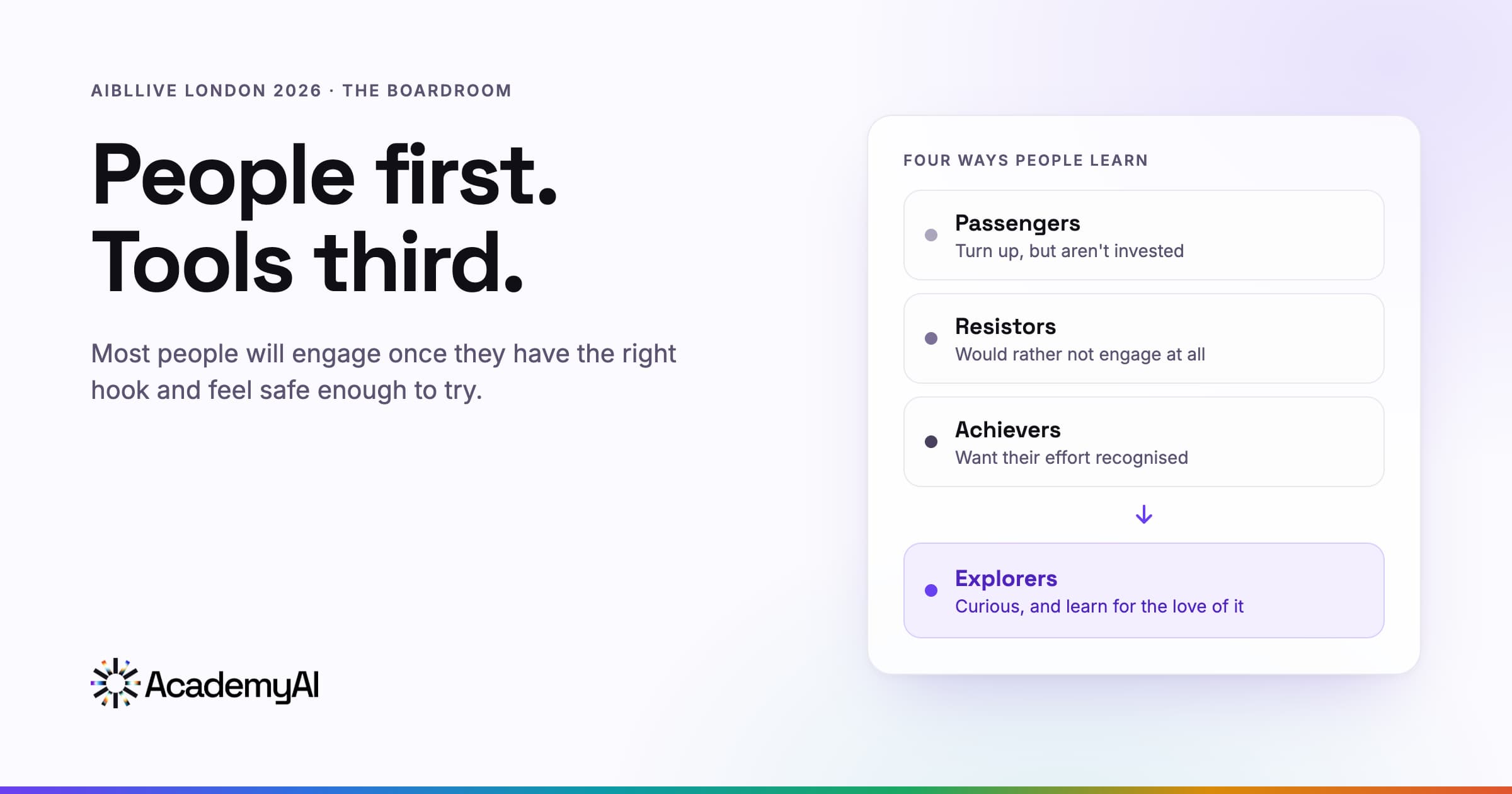
She describes a loud minority and a silent majority. Around 5% of Informa's workforce love AI and adopt everything, and they've become her champions. Her real focus is the other 95%. (Source: Capability Loop Podcast)
Which group is your programme built for? If it's the 5%, your usage numbers will look healthy while most people carry on as before.
Real business problems get people into the room
Donna's main way of reaching the 95% is the learning lab. AI is hard to teach in the abstract, and Informa has a huge range of roles, so each lab starts with a bottleneck in someone's workflow and asks whether AI can help.
People submit problems in advance and attendees vote on which ones to tackle in the three hours. Because the people doing the work have the choice of what to work on, the conversation starts with how AI can take some pressure off: scheduling, sales proposals, campaign briefs for vendors.
The rule is that everyone leaves with a new way of doing something in their own job. Sometimes that means learning their problem can't be solved with AI, and Donna is fine with that. Her five facilitators are experts in facilitation, and the subject matter experts leading the session know where the workflow breaks. Nobody needs to be an AI expert to run one. (Source: Capability Loop Podcast)
The sceptics you didn't expect
The biggest resistance Donna found came from early-careers colleagues. You'd assume digital natives would be first in the queue - but that's not always the case.
Two concerns came up. Will the skills they build now still matter across a 30 or 40 year career? And what is AI doing to the environment? Donna brought in Informa's sustainability team to show them real data on the company's footprint, and she passes what she hears on to the executive team.
If your plan assumes early-careers colleagues are already on board, ask them if that's actually true - their answer may surprise you.
Freedom to build needs guardrails and a home
About a year ago, Informa colleagues started building their own apps and agents. That's exactly the end product that curiosity should produce, and it raises real questions about security and governance. Donna wanted people to keep exploring, safely.
So Informa set up an AI Innovation Council. It brings together an executive chair, the head of AI policy and governance, security, legal, the technical teams and an HR representative from each part of the business. The council weighs risk against value for every idea. Human judgement sits wherever a mistake could hurt people, the business or its reputation. Alongside this, 90 internal apprentices are training as workflow specialists who will build agents of their own.
Donna is candid that this took far more detail than she expected, with much of the testing done by hand at first.
None of it works however, without support from the top of the business. Informa's chief executive, Stephen Carter, has told the workforce that everyone will keep having dedicated time for AI next year. That's rare: only 25% of frontline workers in BCG's survey say their leaders give enough guidance on AI. (Source: BCG)
Donna's most provocative view is that AI belongs with HR. HR already shapes the organisation alongside leaders, understands the people risks and knows who to bring in at the right moment. Put AI there and people sit at the centre of the programme, with human judgement built in from the start.
Where to start
Back to the four steps.
- Measure the work. Pick one team, agree one business outcome with its leader and finance, and track it.
- Design for the quiet majority. Create moments of curiosity and give quieter colleagues the spotlight.
- Start with real problems. Let people vote on the bottlenecks, and make sure everyone leaves with a new way of working.
- Give people freedom inside guardrails. Set up a group that weighs risk against value, and find someone who understands the business and cares about people to lead it.
You can do all of this yourself, or you can do it with AcademyAI. We assess each person's AI capability before training starts, deliver role-specific learning in the flow of work, and evidence the improvement in the work itself. If you'd like to see where your organisation stands, find out more here.
Who owns AI where you work, and is that the right home for it? I'd love to hear what has and hasn't worked for you.
Thanks, as always,
Andy
PS. You can watch my full conversation with Donna, "You can't mandate curiosity", on YouTube.
Sources
- Capability Loop Podcast, "You can't mandate curiosity", with Donna Lovitt-Edwards, Head of AI Fluency at Informa: https://www.youtube.com/watch?v=9bz4H_WdC00
- BCG, "Companies Must Go Beyond AI Adoption to Realize Its Full Potential" (press release on AI at Work 2025: Momentum Builds, but Gaps Remain), 26 June 2025: https://www.bcg.com/press/26june2025-beyond-ai-adoption-full-potential