I went into our Boardroom session at aiblLIVE expecting to spend a good part of the hour on tools, and we barely touched them. The session ran under the Chatham House Rule, so I'll talk about themes and where the focus of the discussion sat. The room kept coming back to people: who's curious, who's switched off, and what it takes to move each of them. I came away thinking that most organisations design their AI programmes for the people who are already keen, then wonder why everyone else doesn't follow. The experience around that table suggested that most people will engage once they've got the right hook and feel safe enough to try.
Being good at AI matters less than what you can actually deliver
We kicked off the discussion by defining AI literacy, and what it means to the attendees. We settled on a broad description that covered understanding use cases and the capability underneath them but increasingly it means orchestrating that capability rather than using one tool after another. One participant described the AI interface as a kind of value elevator that lifts everyone towards higher-value work.
The point that really resonated was about the end goal however. Nobody wanted people who are "good at AI" for its own sake - what matters is the quality of the output, because, fundamentally, performance management always comes back to what someone actually delivers. That's also why the room avoided focusing on the headcount question. Framing AI around delivering more value works far better than framing it around cutting roles.
There was a broad theme that AI adoption and capability was far more a question of people and change than of the technology. One statement that really stood out was "Just because you can doesn't mean you should."
Most people start as passengers, resistors or achievers
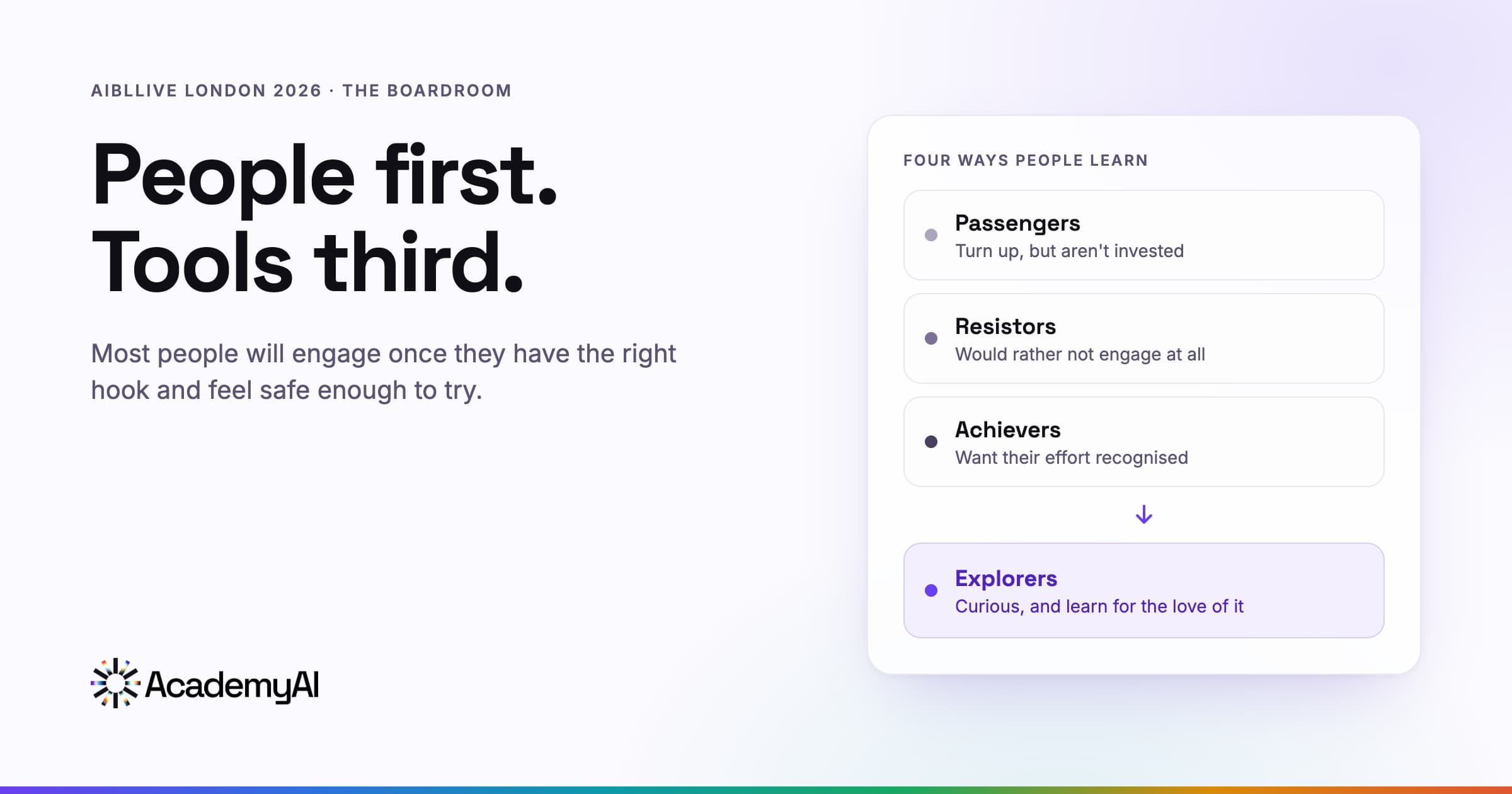
One of the really valuable comments looked at a simple way of thinking about people. Research mentioned in the session sorts learners into four groups. The same four modes appear in Jenny Anderson and Rebecca Winthrop's book The Disengaged Teen, which looks at how young people engage with learning, and they translate well to work.
- Passengers don't really care either way. They'll turn up, but they aren't invested.
- Resistors don't want to engage at all.
- Achievers want recognition, and they get frustrated when their effort goes unnoticed.
- Explorers learn for the love of it. They're curious and intrinsically motivated.
Explorers are the group you want. The hard part is converting the other three. One participant told a story about a family member who'd ignored AI for years, until someone gave them a specific hook that mattered to them. Within an hour they were an enthusiastic user.
The other thing that kept coming up was safety. People won't engage if they don't feel safe asking "silly" questions.
The AI product owner at a national charity described how this has played out in their organisation. In a charity, every use case is judged on the value it brings. Sporadic users started adopting once they saw their peers using AI, and it spread organically from there. A side effect was that people who'd been reluctant became users over time. For the strongest resistors, though, the room was clear that nothing replaces a one-to-one conversation that starts with "what's your story?"
Change the work before you change the tools
The practical advice was simple. Start people with a chatbot, and get them to ask the AI to help write the prompt. Show a bad prompt next to a good one so the difference is concrete, then run it on a real use case, such as a CRM.
For teams, the room recommended use case mapping. You start with the most basic question, "what exactly do you do?", work out what could be automated, and then have a budget-style discussion about it.
Order matters too. The operating model should change first and the technology after it. One participant put tech at decision number three, well behind the people and process decisions, and the room agreed that adoption has to be driven from the leadership and board level down. Someone shared an example from one large tech company, where redesigning work around what brings people joy, and involving people in redesigning their own processes, was linked to higher productivity.
Underneath all of this was a recognition that the nature of work has already changed, and people are now learning a new job. The comparison that came up was typing, which was once a skill you went to school to learn and is now elementary.
Juniors and measurement are still unsolved
Two of the hardest questions stayed open, and they are still something we need to think about.
The first was about junior roles. The brand operations leader at a global bank said they're curious about how to motivate people, and that the entry point is always bringing AI into a task. Their concern was that those at the beginning of their careers often lack the appetite to learn without AI as a scaffold, and that if AI makes those junior roles redundant, it isn't clear how people will develop into senior ones. Other participants added that these early stage workers don't yet know how to apply context and common sense to what AI gives them and this led onto a conversation about how critical thinking was fast developing as the key core transferable skill. Being "good at AI" might be subjective, but strong judgement isn't, and the room felt that people without it are putting their future employment at risk. Nobody had a confident answer on how to build that judgement if the traditional entry level role disappears.
The second was measurement. AI capability is hard to quantify directly, and someone asked a question we hear a lot: how do you point at a person who's good at AI and explain why? The best example shared was how to start with the use case and measure the value delivered. That's close to how we work at AcademyAI. We assess each person's AI capability before training starts, build role-specific learning into the flow of work, and then show the improvement in the work itself.
The conversation could have gone on for hours and we're looking forward to continuing these vital discussions at our new Breakfast Seminar series for senior leaders grappling with these conversations - stand by for more details on these.
If you want to try this yourself, start with the four types. Think about who in your team is a passenger, a resistor, an achiever or an explorer, and what's going to move each of them one step along. You can do that on your own but if you'd like help assessing where your people are and building learning around their actual work, that's what we do at AcademyAI.
Find out more here: https://academyai.co/
Sources