
Practitioner story · NHS

From prompting to organisation wide agents in the NHS, one step at a time.

How one transformation leader turned individual enthusiasm into safe, governed value across a large and highly regulated organisation.

From the Capability Loop podcast, with Rory Hill. Lessons any leadership team can apply, whatever AI tools you use.

Read the 4 lessons
At a glance
steps from a single prompt to organisation wide agents
5
sequenced sessions, with usage many multiples higher
3 to 5
tests before an idea is scaled: people, technology, reuse
3
in programme management and governance
13 years
The starting point

Sitting at the bottom of the J curve.

Like most organisations, this one had moved through the excitement and experimentation phases and arrived at implementation. That usually means sitting at the bottom of the J curve, where AI shows up first as extra cost and effort long before the benefits arrive.

It is an uncomfortable place to be, because everyone else appears to be further ahead. Plenty of organisations that rolled out AI licences a year ago are still mostly using them to summarise meetings.

Rory had an unusual head start. Seeing where AI was heading, he moved to a four day week so he could spend one day a week experimenting. When the organisation rolled out an AI assistant, he was ready, and his early pilots went well. The lasting value, though, came from the structure he built so others could follow faster.

64%of workers used AI at work in the past year, up ten points.PwC · Global Workforce Hopes and Fears Survey, 2026
51%say they can access the learning they need, down from 59%.PwC · Global Workforce Hopes and Fears Survey, 2026
The lessons

Four lessons in scaling AI safely.

Structure, sustained learning and clear rules for what gets scaled, not the technology itself.

Personal productivity is a step, not a destination

Rory describes AI adoption as a stair step. Each stage is small enough for people to grow into, and each changes how they think about the work, not just the tool.

  1. 01PromptingGetting started with an assistant. Control: acceptable use policy.
  2. 02Saved promptsReuse leads people to improve what they write. Control: shared guidance.
  3. 03Personal agentsAssistants pointed at the right documents. Control: data access checks.
  4. 04Team agentsNow there is a customer for what was built. Control: ownership and testing.
  5. 05Organisation wideDoes it work for everyone? Control: full governance.

Controls needed at each step.

The real value is what hangs off the structure. Each step carries its own controls, and one shared picture lets the team explain to any part of the organisation what must be in place before a use case can happen.
One training session is an event; five is a programme

Usage rises after a single training session. But when the team compared people who attended one session with those who attended three, four or five in sequence, the second group’s usage was many multiples higher.

A training session is an event. Capability is a state.

Riordan (Rory) Hill, Head of Corporate Transformation and AI

The goal is people thinking differently about the work itself: spotting opportunities, thinking in systems and redesigning how work gets done. Automating what you already do will not get you very far.

Scale with purpose

With a small team and lots of ideas, prioritisation matured over time. It began with backing the most eager builders, then moved to impact (how many people helped, and by how much), and now adds further tests.

Digital maturity: people
Does the requesting team have a subject matter expert ready to test outputs and give feedback? Without that person, a solution is a novelty no one uses.
Digital maturity: technology
Are the controls in place to support something this complex, and if not, when will they be?
Reuse
Is the use case built from parts that will serve future solutions? A shared mailbox agent sits inside many later builds, making each one cheaper.

Combining these turns a flat no into a not yet, with a date to revisit. That converts frustration into pent up demand, which in turn pushes the organisation to fund the governance work it needs.

Return is more than money

Before building anything beyond personal productivity, write down the problem being solved, the benefit expected and where you will be able to see it afterwards. Skip this and you can be deep into a complex build before realising it may not deliver.

  • Time saved
  • Staff experience
  • Patient experience
  • Quality of work
  • Cost

Benefits should also be profiled over time: personal productivity shows up early and almost everyone feels it, while organisational efficiency comes later and is harder won.

What changed

What changed.

The organisation now has a clear, shared route from an individual’s good idea to a governed, organisation wide solution, so others get there faster than Rory did.

  • Before: Tools rolled out, mostly used for simple tasks
    After: A staged path from prompting to organisation wide agents
  • Before: One off training sessions
    After: Sequenced learning, with usage many multiples higher
  • Before: Building whatever looked good in a demo
    After: Scaling based on impact, readiness and reuse
  • Before: Unclear rules for what can be scaled
    After: Controls mapped to each stage, explained in one picture
  • Before: A flat no for ambitious requests
    After: A dated not yet that builds demand for governance
  • Before: ROI judged on early efficiency numbers
    After: Benefits profiled over time, beyond money alone
Questions for your organisation

Take these into your next leadership conversation.

On scaling

If someone built something genuinely useful tomorrow, could anyone tell them what it would take to scale it?

On learning

Is your AI training an event or a programme, and how many touchpoints does a typical colleague get?

On prioritisation

When you say no to an AI idea, do you give a date for when it could become a yes?

On return

Does your business case say when each type of benefit should appear, so early quarters are not mistaken for failure?

How AcademyAI helps

An AI training programme, not an event.

AcademyAI gives regulated organisations a sequenced path from first prompt to governed workflows, with evidence of capability at every step.

01 · Sequence

Learning that builds, session by session.

A fundamentals path, then role-based courses, in short sessions in the browser or in Slack, so every colleague gets many touchpoints, not one.

From this story: One training session is an event; five is a programme.

02 · Govern

Safe use built in at every step.

Safe & Responsible Use is scored for everyone, and your own policies are loaded as context, so training reflects the controls at each stage.

From this story: Personal productivity is a step, not a destination.

03 · Prove

Readiness you can see before you scale.

Capability by team and role shows which teams have the skills to test and own a solution, and re-assessment shows benefits building over time.

From this story: Scale with purpose.

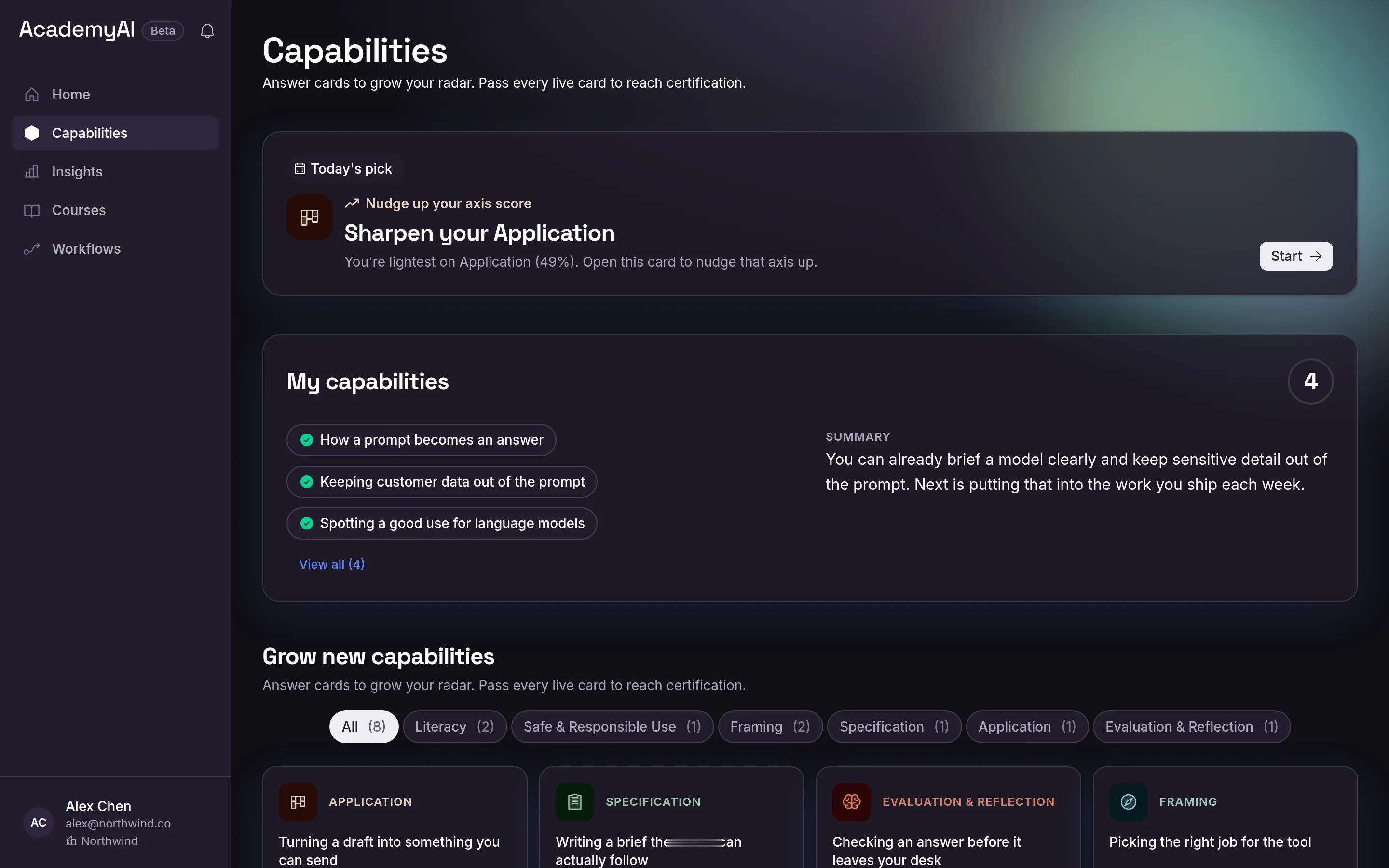
Capabilities
AcademyAI capability radar scoring a team on the six capabilities

Capability, measured in six.

Every role is scored on Literacy, Safe & Responsible Use, Framing, Specification, Application and Evaluation & Reflection. Works with ChatGPT, Copilot, Claude and Gemini.

  • Baseline every role with a short, scored assessment, not a usage report.
  • See gaps by team and role on one capability radar.
  • Re-assess and certify, so leadership sees what changed.
Questions

AI adoption in the NHS and public sector: common questions.

Something else? Talk to the team.

How can NHS and public sector organisations adopt AI safely?

Rory Hill describes adoption as a stair step: prompting, saved prompts, personal agents, team agents, then organisation wide. Each step is small enough for people to grow into, and each carries its own controls, from an acceptable use policy through to full governance. One shared picture shows what must be in place before a use case can happen.

Is one AI training session enough?

Usage rises after a single session. When the team compared people who attended one session with those who attended three, four or five in sequence, the second group’s usage was many multiples higher. A training session is an event. Capability is a state.

How do you decide which AI use cases to scale?

Prioritisation began with backing the most eager builders, then moved to impact: how many people helped, and by how much. It now adds three tests. Does the team have a subject matter expert ready to test outputs? Are the controls in place, and if not, when will they be? Is the use case built from parts that will serve future solutions? A flat no becomes a not yet, with a date to revisit.

How do you avoid AI agent sprawl?

Controls are mapped to each stage, and an idea is scaled only when the team is ready and the parts can be reused. A shared mailbox agent, for example, sits inside many later builds, so building it well once makes each later one cheaper. The programme moved away from building whatever looked good in a demo.

How should we measure the return on AI in the public sector?

Before building anything beyond personal productivity, write down the problem being solved, the benefit expected and where you will be able to see it. Here the benefits counted are time saved, staff experience, patient experience, quality of work and cost. Personal productivity shows up early. Organisational efficiency comes later, and is harder won.

Does AcademyAI work with Microsoft Copilot?

Yes. AcademyAI works with Copilot, and with ChatGPT, Claude and Gemini. Safe & Responsible Use is scored for everyone, and your own policies are loaded as context.

More from AI practitioners

Practitioner stories from people doing the work.

Sources

  1. Andy Lambert, From prompting to organisation wide agents, one step at a time, Capability Loop, 23 October 2026
  2. Capability Loop Podcast, episode with Riordan Hill
  3. Riordan Hill on LinkedIn and riordanhill.com
  4. PwC, 2026 Global Workforce Hopes and Fears Survey
Your next step

Scale AI safely, one step at a time.

Get a capability radar for your organisation and a sequenced plan from first prompt to governed, organisation wide agents.